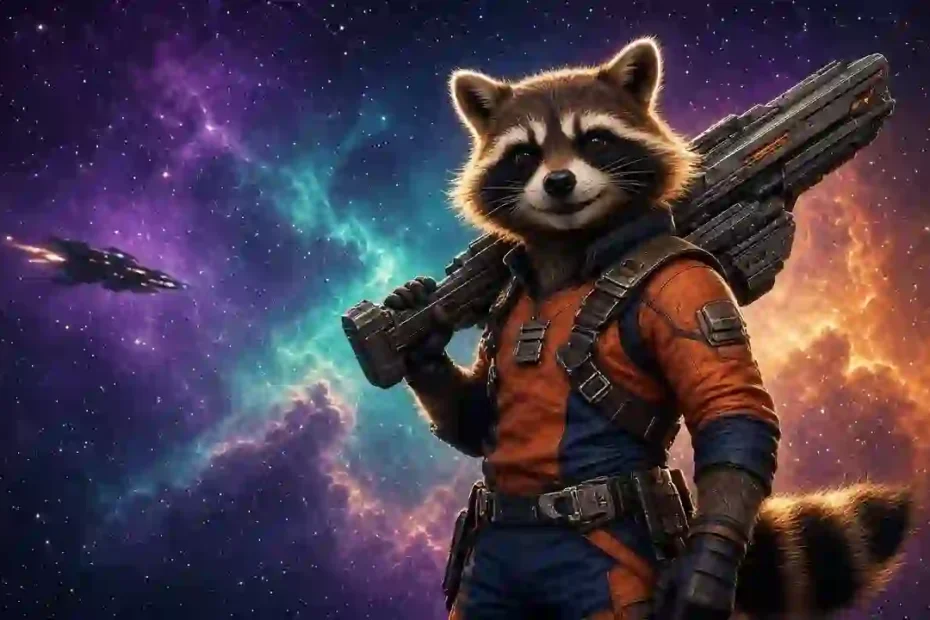
A raccoon with a rocket launcher shouldn’t be able to make a theater full of adults cry. Yet that’s what happened in 2023, when the Guardians’ Rocket Raccoon stopped being the funny one and turned out to be the heart of the whole trilogy.
So how did a throwaway gag from a 1970s comic get there? In this guide, you’ll learn where he came from, what he can actually do, how the films reshaped him, and which movies, comics, and games deserve your time. You won’t need any comic-shop homework to follow along.
Quick Overview
- First appearance: Marvel Preview #7 (1976), where he was called “Rocky”
- Creators: writer Bill Mantlo and artist Keith Giffen
- Name inspiration: The Beatles’ 1968 song “Rocky Raccoon”
- On screen: voiced by Bradley Cooper, performed on set by Sean Gunn
- Core skills: engineering, piloting, marksmanship, and battlefield tactics
- Essential viewing: Guardians of the Galaxy Vol. 3 (2023), which reveals his origin
Who Is Rocket, Exactly?
Definition: Rocket is a fictional Marvel character, a raccoon whose body and mind were altered by genetic and cybernetic experiments. Those changes gave him human-level intelligence, speech, and the ability to walk upright. He’s best known as a core member of the Guardians of the Galaxy, a crew of misfits who protect the cosmos and bicker the entire time.
If you’re brand new, here’s the lineup he runs with. There’s Peter Quill (the self-styled Star-Lord), the assassin Gamora, the very literal Drax, and Groot, a walking tree with a three-word vocabulary. Rocket is the one who fixes the ship, designs the weapons, flies the getaway, and usually comes up with the plan.
His personality is the hook. He’s sarcastic, quick-tempered, and allergic to sentiment, and he can’t stand being treated like an animal. Over the years he’s been called a rodent, vermin, a trash panda, and (by Thor) a rabbit. Only the last one gets a pass.
So why do so many people love him? Because the attitude is plainly covering something. The more you learn about what was done to him, the more those sharp edges start to look like scar tissue.
Where Did the Character Come From?
He started small. Writer Bill Mantlo (a prolific Marvel scripter who also co-created Cloak and Dagger) and artist Keith Giffen introduced him in 1976, in a backup story tucked inside the black-and-white magazine Marvel Preview #7. He was a side character called “Rocky,” and nobody was pitching him as a future film star.
The name was a wink at The Beatles’ 1968 song “Rocky Raccoon.” When Mantlo brought him back in The Incredible Hulk #271 in 1982, readers learned that Rocky was short for Rocket. The issue kept the joke going with a plot about a book called Gideon’s Bible, a phrase borrowed from the song’s lyrics.
In 1985 he earned a four-issue miniseries of his own, drawn by a young Mike Mignola years before he created Hellboy. It fleshed out his home, Halfworld, a strange planet where intelligent animals looked after the human patients of a deep-space asylum. Rocket was its ranger, and his circle included an otter named Lylla and a walrus called Wal Rus.
A real-world story worth knowing
Mantlo’s own life took a hard turn. In 1992 he was struck by a hit-and-run driver and left with a brain injury that has required full-time care ever since. When the first film arrived in 2014, Marvel arranged a private screening for him, and his name appears in the credits. His brother Michael called it “the greatest day of the last 22 years” for the family.
How Does the Guardians of the Galaxy Rocket Raccoon Differ From the Comics Original?
After that miniseries, he more or less vanished. He appeared in only about ten comics during his first thirty years, until Giffen pulled him into a 2007 space-war story alongside Star-Lord and Groot. A year later, writers Dan Abnett and Andy Lanning made him the tactician of a relaunched Guardians team, and that lineup became the template for the 2014 film.
Director James Gunn kept the attitude and the love of oversized guns. What he rewrote was the past. Here’s how the two versions line up.
| Original comics (1976–1985) | Films (2014–2023) | |
|---|---|---|
| Where he’s from | Halfworld, an asylum planet in the Keystone Quadrant | A laboratory run by the High Evolutionary |
| Why he was changed | Robots upgraded the colony’s animals so they could care for its patients | He was a test subject in a scheme to engineer a “perfect” society |
| First friends | Lylla the otter and Wal Rus the walrus | Lylla the otter, Teefs the walrus, and Floor the rabbit |
| Job when you meet him | Ranger protecting Halfworld | Bounty hunter partnered with Groot |
| Feelings about “raccoon” | It’s part of his name from 1982 onward | He rejects the word until Vol. 3 |
| Overall tone | Whimsical, storybook science fiction | Funny on the surface, painful underneath |
The pattern is easy to spot. The comics gave him a purpose from the start, while the films gave him a wound. That single change is why the screen version feels heavier, even when he’s cracking jokes. It also explains why he’s angrier on screen than he ever was on the page.
The films also paid the comics back. Cartoonist Skottie Young launched a new solo series in 2014, timed to the movie’s release, and its first issue reportedly sold more than 300,000 copies. Not bad for a character who’d spent decades as a trivia answer.
What Makes Rocket Raccoon in Guardians of the Galaxy So Compelling?
It comes down to a simple trick done very well. The films let you laugh at him first, then show you why he’s like this. Four moments across the series carry most of that weight.
- The police lineup (2014). A Nova Corps officer reads his file aloud: Subject 89P13, “the result of illegal genetic and cybernetic experiments on a lower life form.” It plays as a joke, but it’s your first clue that someone built him.
- The drunken outburst (2014). After one insult too many, he snaps and shouts, “I didn’t ask to get made!” In a few seconds, you realize the wisecracks are armor.
- Yondu’s speech (2017). In Vol. 2, the blue-skinned outlaw Yondu calls out his habit of pushing people away before they can leave him. Rocket has no comeback, which says plenty.
- Thor’s “Rabbit” (2018 and 2019). In Avengers: Infinity War and Endgame, he becomes an unlikely source of steadiness for a grieving Thor. The god of thunder never gets his species right, and for once Rocket doesn’t mind.
Then there’s Groot. In the first film, Rocket is the only one who understands what “I am Groot” means from one moment to the next, which tells you how long these two have relied on each other. When Groot sacrifices himself in the finale, the toughest talker on the team is the one who falls apart.
Bradley Cooper’s voice work ties it together. He plays the character fast, gravelly, and permanently irritated, then lets the hurt slip through at the right moments. You stop seeing a visual effect and start seeing a person.
If you tell stories for a living, notice the order of operations. You’re given reasons to like him long before you’re asked to feel sorry for him. That’s why the sympathy never feels forced.
How Does Vol. 3 Complete His Story?
Fair warning: this section spoils the 2023 film. Early in Guardians of the Galaxy Vol. 3, Rocket is badly wounded by a hunter sent to drag him back to his creator, who wants to study the one inventive mind he’s never managed to copy. His friends then discover a kill switch in his body that blocks any treatment. He spends most of the running time unconscious while they race to steal the override code.
While he’s out, the film shows you what he remembers. As a baby raccoon, he was taken by a scientist called the High Evolutionary, tagged with a number, and rebuilt piece by piece. His only comfort was three fellow test subjects who chose their own names and dreamed with him about seeing the sky.
- Lylla, a gentle otter with mechanical arms (voiced by Linda Cardellini)
- Teefs, a big-hearted walrus on wheels (voiced by Asim Chaudhry)
- Floor, an excitable rabbit with metal legs (voiced by Mikaela Hoover)
The escape goes wrong, and he’s the only one who makes it out. Years later, in the film’s climax, he goes back for the caged animals on the High Evolutionary’s ship and finds a pen of baby raccoons with their species printed on the label. When his creator calls him by his number one last time, he answers with a name instead. For the first time, it includes the word he’s spent three films rejecting.
None of this was an accident. Gunn told Total Film that Rocket “is the secret protagonist of the Guardians of the Galaxy, and has always been the center of it for me.” The film’s unflinching look at animal experimentation also earned Gunn a “Not a Number” award from the animal rights group PETA in May 2023. It ends with Rocket as the team’s new captain.
What Are His Powers, Skills, and Weapons?
Here’s the surprise: he doesn’t have powers in the usual superhero sense. He can’t fly, lift cars, or fire energy from his hands. What he has is a first-rate brain, steady paws, and very little caution. In practice, that adds up to five skills.
- Engineering. He builds weapons, bombs, and gadgets out of whatever’s lying around. In the first film he introduces a cannon called the Hadron Enforcer as “a weapon of my own design,” and by Endgame he’s helping Tony Stark build a time machine.
- Marksmanship. He’s an expert shot, usually with a gun that looks far too big for him. He holds his own on the front line of the biggest battles in Infinity War and Endgame.
- Piloting. He flies the team’s ships and argues constantly with Peter Quill over who’s better at it.
- Tactics. He boasts that he’s escaped 22 prisons, and the breakout in the first film is his plan from start to finish.
- Animal instincts. He’s small, quick, a natural climber, and hard to hit. The comics also credit him with heightened senses.
As for weapons, he favors whatever’s biggest. On screen that usually means a heavy energy rifle, homemade bombs, and the odd booby trap, like the ones he uses to pick off a crew of Ravagers in the forest in Vol. 2. In the 1980s comics, he carried a laser pistol and zipped around on rocket-powered skates.
There’s also a running gag you’ll come to love: he’s fascinated by other people’s prosthetic body parts. He demands a fellow prisoner’s artificial leg in the first film for no reason except that he finds it funny. By Infinity War he’s trying to buy Bucky Barnes’s metal arm, and in the 2022 Holiday Special he finally receives it as a gift.
His weaknesses are just as clear. He’s physically fragile next to his teammates, his temper lands him in trouble, and he steals almost by reflex. Pocketing a few valuable batteries from a client is what kicks off the entire plot of Vol. 2.
How Do Filmmakers Bring Him to Life?
On screen he’s entirely computer-generated, but calling him “animated” undersells the work. Each scene is built from four layers, handled by different people.
- A real animal. Artists studied a raccoon named Oreo to get the look and movement right. Oreo joined James Gunn on the red carpet at a 2014 premiere, and according to BBC News, he died in 2019 at the age of 10.
- A performer on set. Actor Sean Gunn played the scenes in a crouch at raccoon height. That gave his co-stars a real scene partner and gave animators a physical performance to build on.
- A voice. Bradley Cooper records the dialogue separately, away from the set.
- Digital artists. The effects studio Framestore, which has animated him since the first film, worked with other effects houses to turn those ingredients into fur, eyes, and expressions.
The results earned real recognition. All three Guardians films received Academy Award nominations for Best Visual Effects. Vol. 3 raised the difficulty again, because its flashbacks ask you to believe in a cage of digital animals with no human face anywhere in the shot.
There’s a recent footnote, too. In September 2026, Sean Gunn said on the Main Character podcast that he considers himself retired from the physically punishing on-set role. Whoever crouches in his place next will inherit a method that clearly works.
If you write, animate, or build brands for a living, that method is worth studying. No single department owns him. He works because a writer’s empathy, one actor’s body, another actor’s voice, and an animator’s patience are all aimed at the same emotional target.
Is He Anything Like a Real Raccoon?
More than you’d think. Real raccoons (Procyon lotor) are native to North America, and they share his black mask, ringed tail, and stubborn curiosity. They’re also famous for the trait that defines him: clever hands.
The English word comes from the Powhatan term aroughcun, often translated as “animal that scratches with its hands.” Their front paws are extremely sensitive, and they’re notorious for working out latches, jars, and trash can lids. Some studies even suggest they can remember the solution to a task for up to three years. So a raccoon who can strip down an engine is an exaggeration of something true.
| Real raccoon | Rocket | |
|---|---|---|
| Movement | Walks on all fours and stands up to inspect things | Walks upright full-time |
| Hands | Sensitive, nimble front paws | The same idea, plus a welding torch |
| Active hours | Mostly at night | Whenever there’s something to steal |
| Sounds | Chitters, growls, and purrs | Sarcasm, mostly |
| Home | Forests, wetlands, and cities | A spaceship full of friends |
There’s a neat thematic fit as well. Raccoons are opportunists, famous for making a living from what people throw away, and Rocket builds his best inventions out of scrap. Even the black “bandit mask” suits a character who starts out as a thief.
One practical note, since the films make them look so appealing. Raccoons are wild animals that can bite and carry diseases, and keeping one is restricted or illegal in many places. Admire them from a distance, and let the fictional one be your favorite.
Where Should You Start If You’re New?
You don’t need to read a single comic first. The films tell his story in order, and each one builds on the last. For the full arc, watch his appearances in this sequence.
- Guardians of the Galaxy (2014). The introduction, the prison break, and the first hints of his past.
- Guardians of the Galaxy Vol. 2 (2017). His self-sabotage and his odd kinship with Yondu.
- Avengers: Infinity War (2018). A side quest with Thor and a teenage Groot.
- Avengers: Endgame (2019). Life after loss, and a mission back in time to Asgard.
- Thor: Love and Thunder (2022). A brief appearance alongside the team.
- The Guardians of the Galaxy Holiday Special (2022). Short, silly, and home to a very good gift.
- Guardians of the Galaxy Vol. 3 (2023). His origin and the end of the trilogy.
Short on time? Watch numbers 1, 2, and 7. The trilogy stands on its own, and the third film lands hardest when the first two are fresh in your mind. If you only have one evening, the 2014 original still works as a complete story.
If you’d like to try the comics, three entry points stand out. The 1985 miniseries shows the oddball original, the 2008 Guardians run by Abnett and Lanning introduces the modern team, and Skottie Young’s 2014 solo series is the funniest and friendliest for beginners. All three are available in collected editions.
He’s easy to find outside the films as well. In the 2021 game Marvel’s Guardians of the Galaxy, you play as Star-Lord and give him orders he rarely enjoys, while the team shooter Marvel Rivals casts him as a Strategist who heals and revives allies. Younger viewers can try the animated Guardians of the Galaxy series that began in 2015, where Trevor Devall provides the voice. And at Disney California Adventure, an animatronic version of him briefs riders on the escape plan in Mission: Breakout!
Key Takeaways
- He began as a minor 1976 comic character named after a Beatles song and stayed obscure for about thirty years.
- A 2008 comics relaunch and the 2014 film turned him into one of Marvel’s best-loved heroes.
- He has no superpowers. His strengths are engineering, piloting, marksmanship, and planning.
- The films replaced his whimsical comic origin with a darker one, revealed in full in Vol. 3.
- On screen he’s a team effort: a real raccoon for reference, an actor on set, a voice actor, and hundreds of digital artists.
Frequently Asked Questions
Is Rocket Raccoon a real raccoon?
In the story, yes. He was born an ordinary raccoon and was altered by experiments that gave him intelligence and speech, which Vol. 3 confirms when he finds a cage of raccoon kits. On screen he’s a digital creation, although artists based his appearance and movement on a real raccoon named Oreo.
Who voices Rocket in the Guardians of the Galaxy movies?
Bradley Cooper has voiced the adult character in all of his film appearances since 2014, while Sean Gunn performed the role on set as a reference for the animators. In the Vol. 3 flashbacks, Sean Gunn also voices the younger version, and Noah Raskin voices him as a baby.
Who created Rocket, and when did he first appear?
Writer Bill Mantlo and artist Keith Giffen created him for Marvel Comics. He first appeared in Marvel Preview #7 in 1976 under the name “Rocky,” a nod to a Beatles song. He returned in a 1982 Hulk comic and received his own four-issue miniseries in 1985.
What does 89P13 mean?
It’s the laboratory designation he was given as a test subject. A Nova Corps officer reads “Subject 89P13” from his file in the 2014 film, and Vol. 3 shows he belonged to the High Evolutionary’s Batch 89. He rejects the number and insists on the name he chose for himself.
Does Rocket die in Guardians of the Galaxy Vol. 3?
No. He’s critically injured early in the film, and his heart stops for a moment near the end, but his friends revive him after disabling the kill switch. He recovers, confronts the High Evolutionary, and finishes the film as the new captain of the Guardians.
Will Rocket be in Avengers: Doomsday?
Not officially. The film is due in theaters on December 18, 2026, and as of mid-November, Marvel hasn’t announced him or any Guardians cast member for it. Reports of a return remain unverified rumors. His most recent major appearance is still Vol. 3, which ends with him leading a new version of the team.
Conclusion
He started as a pun on a Beatles song and spent thirty years as a footnote. Then a handful of writers, one director, an actor in a crouch, a voice in a recording booth, and hundreds of animators decided to take a talking raccoon seriously. Audiences did the same.
That’s the idea worth holding on to: no character is too small or too strange to matter once you understand what they’ve survived. It took him three films to say his full name out loud, so it’s only fair that he gets the last word here.