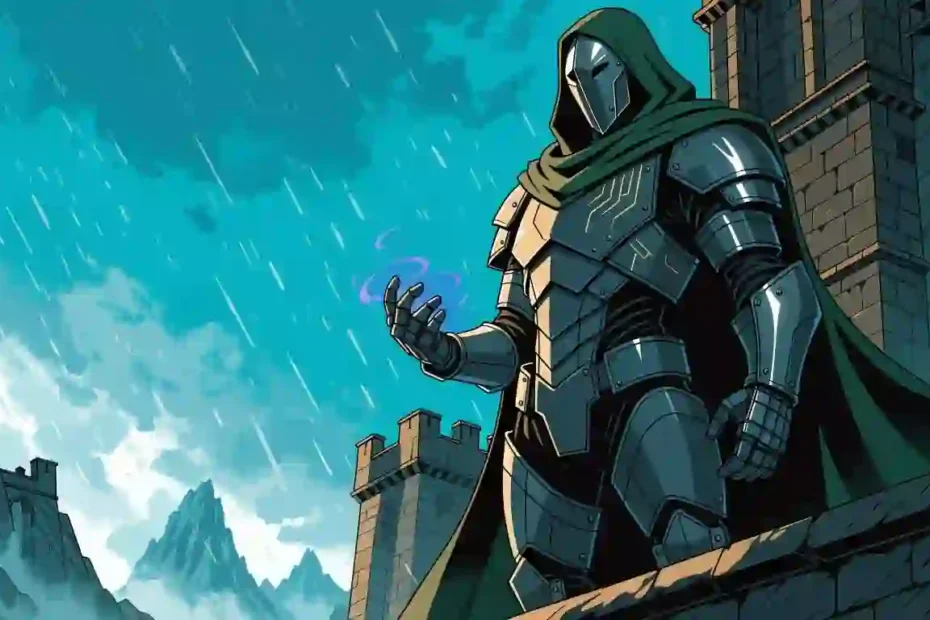
A man in a metal mask decided the universe would run better if he were in charge. For a brief stretch in the mid-1980s, he was arguably right.
Doctor Doom has been stealing scenes since 1962, and he’s still the character writers reach for when they need a villain with a kingdom, a grudge, and a plan. If you’ve only seen the mask, this fills in the rest: where he came from, what the armor does, which stories actually matter, and how to read them without a decoder ring. You’ll also get a sense of why a character from the early sixties keeps earning new books, new cartoons, and fresh arguments among fans.
Quick Overview
- First appearance: The Fantastic Four #5, cover-dated July 1962, by Stan Lee and Jack Kirby.
- Real name: Victor Von Doom, absolute ruler of Latveria, a fictional Central European nation.
- Look: a forged metal mask under a green hood, powered armor, and a voice that rarely rises.
- Skills: engineering, statecraft, and sorcery — plus robot doubles that stand in for him.
- Motivation: to prove he’s the smartest person alive, and to free his mother’s soul from Hell.
- Best starting points: the 1962 debut, Books of Doom (2005–06), and Secret Wars (2015).
Who Created Him, and Where Did He First Appear?
He turned up in The Fantastic Four #5, cover-dated July 1962, in a story by writer Stan Lee and artist Jack Kirby. At that point the Fantastic Four themselves were less than a year old, having launched in November 1961. A villain with a castle and a title arriving in issue five was a fast escalation for a brand-new book.
The debut is a compact adventure: the team is lured to a European castle, sent after a pirate’s treasure across time, and forced to outthink a host who has planned three moves ahead. Nobody explains where the mask came from or why he’s called a doctor. Readers got a presence, not a résumé — and that turned out to be exactly the right order.
What made the issue stick was the shift in scale. Earlier Marvel monsters tended to arrive, cause trouble, and vanish; this one had a country, a throne, and a personal history waiting off-panel. He came back in issue after issue, and each return added a little more furniture to the world around him.
Why 1962 mattered
Comics in the early sixties were full of rockets, laboratories, and Cold War tension, so a scientific monarch with a private army fit the moment neatly. Kirby’s design did half the work: hood, metal face, heavy gauntlets, and a cloak that reads clearly even at thumbnail size. You can tell who he is from a silhouette alone, which is a rare and useful thing on a crowded newsstand.
Lee and Kirby worked in a loose, collaborative way — plots hashed out together, pages drawn first, dialogue fitted afterward. That method gave the early stories their speed and their slightly odd swings in tone. A scene could be a pulp trap on one page and a dry joke on the next, and the character absorbed both without cracking.
What the first issue left out
The 1962 story gives you almost no biography. There’s no name for his country, no explanation of the mask, and no hint of the accident that made it necessary. That restraint was unusual for the period, when a villain often arrived with a paragraph of exposition and a neatly stated motive.
Leaving blanks works only when the character is interesting enough to make readers want them filled. Here, the blanks became a hook that pulled people back for the next issue. It’s also why the 1964 annual landed so well: two years of speculation meant an origin story arrived as an answer rather than a homework assignment.
The origin arrived two years later
The backstory finally appeared in Fantastic Four Annual #2 (1964), also by Lee and Kirby, in a handful of pages that laid out the accident, the scar, and the mask. Decades later, Ed Brubaker and Pablo Raimondi expanded the same beats into Books of Doom (2005–06), a six-issue character study that’s now the most recommended version.
Those two books are worth comparing. The 1964 annual tells you what happened; the 2005 miniseries asks why he keeps telling it the way he does. Same facts, different question — and that’s a pattern you’ll see all through his publishing history.
Who Is Doctor Doom, Really?
In plain terms: Victor Von Doom is the ruler of Latveria, a scientist and sorcerer who wears powered armor and a metal mask over a scarred face. He has no inborn superpowers. What he has is a country, an army of robots, a formidable intellect, and a settled conviction that he alone should be making decisions for everyone else.
Here’s the detail that changes how you read him: he’s a head of state first and a costumed villain second. In plenty of stories, that status comes with diplomatic immunity, so the heroes can’t simply drag him off to jail after a fight. He can sign treaties, host summits, and then go home to a castle that no one is allowed to enter.
The name is worth a second look too. “Von Doom” is the family surname in the story, not a stage name he dreamed up. The “Doctor” is the part he awarded himself after leaving university before he’d finished, and that small act of self-coronation tells you almost everything about the man inside the suit.
So why the metal face? Because the injury is the one thing his intellect can’t revise. He can rebuild a country, out-engineer a rival, and talk his way out of a treaty, but he can’t go back to the calculation he refused to check.
Two toolkits, one temperament
Most characters pick a lane: science or magic. He refuses to, and he doesn’t treat the two as opposites. To him, a circuit and a spell are both systems with rules, and rules can be learned, tested, and improved. That’s why a story about a lab machine and a story about a trip to Hell can feel like they feature the same person.
Triumph and Torment (1989), by Roger Stern and Mike Mignola, is the clearest example. He teams up with Doctor Strange, travels into Hell, and briefly wins his mother’s soul free. The quest is emotional; the approach is methodical. He negotiates, calculates, and prepares as if he were filing paperwork — which is exactly the joke and exactly the tragedy.
He also keeps a code, even if it’s an unlovely one. He gives his word and generally keeps it, and he looks after the people of Latveria in his own high-handed way. Several stories describe the country as orderly, well-fed, and closely watched: nothing is scarce except the right to disagree.
How Did a Scarred Student Become a King?
The origin is a chain of choices rather than a single bad afternoon. Read the beats in order and you’ll notice that each one is something he decides, not something that happens to him.
- A childhood in Latveria. Victor is born to Werner, a healer, and Cynthia, a Romani sorceress. His mother dies after a clash with local authorities; his father later dies trying to get the boy to safety. Those two losses become the engine of the whole character.
- An education nobody supervised. He grows up among his mother’s people, works through her books of magic, and teaches himself mechanics. By his teens he’s building devices that draw attention from an American university.
- America, and a classmate named Reed. He enrolls — later stories call the school Empire State University — and meets Reed Richards. Reed spots a flaw in the calculations for a machine meant to contact the dead, and Victor refuses to recheck them.
- The explosion. The device blows up, scarring his face and ending his studies. In the 1964 telling, he blames Reed rather than his own arithmetic. That refusal to accept correction is the one trait every later writer keeps.
- Tibet, and the mask. Monks nurse him back to health; he studies with them and has a suit of armor forged. In the 2005 retelling, he presses the still-hot mask onto his own face, so that no one else will ever be the one who put it there.
- The throne. He returns to Latveria, deposes its ruler, and takes the country. The capital gets a new castle, and the world gets a head of state who answers to nobody.
- The unfinished business. Each year he tries to reach his mother’s soul, trapped in Hell. It’s the quest behind Triumph and Torment, and it’s the closest thing he has to a private life.
Notice how little of this requires a villain. Grief, pride, one unexamined calculation, and a talent for building things would be enough to make an ordinary difficult person. The armor and the country are what happen when that person also happens to be a genius with an army.
That’s the useful lens for every story since. When a plot gives him a chance to say “I was wrong,” watch how fast he changes the subject. Writers have been using that flinch as a plot device for more than sixty years.
What Does the Armor Actually Do?
It’s easy to read the suit as costume, but the stories treat it as equipment with specific jobs. Why bother with all that hardware when you could simply give a character super-strength? Because the hardware is the point: it’s what a person without powers builds to stand next to people who have them.
A four-part breakdown
- The armor. A powered metal shell with gauntlet-mounted energy blasts, a personal force field, and short-range flight. It lets him stand in the same room as super-strong opponents without needing super-strength of his own.
- The mask. It hides the scars, filters the air, and holds sensors and communications gear. More than that, it’s a promise: he doesn’t take it off in front of people, and almost no one has seen what’s underneath.
- The doubles. “Doombots” are robot copies built to look, sound, and argue like the original. When a hero knocks him down and the faceplate comes away showing wiring, the fight was with a decoy and the real man is elsewhere.
- The wards. Spells are worked into the metal itself, so mystical attacks meet the same layered defenses as physical ones. This is the part that surprises readers who assumed he was purely a man of science.
Put those together and you’ll see why a fistfight rarely settles anything. Wreck a robot, crack a force field, outspell him for a minute — there’s always another layer, and usually another exit.
What the armor can’t fix
His real weak point isn’t in the schematics. It’s the temper that makes him treat any correction as an insult, and the need to be seen as the author of every good outcome. Writers keep handing him absolute power just to show that the one thing he can’t engineer is contentment.
In the 1984–85 Secret Wars, he takes the energy of a near-omnipotent being called the Beyonder and still measures himself against Reed Richards. In the 2015 event of the same name, he rules a stitched-together planet and still can’t let go of an old argument. The pattern is the point: upgrade the hardware all you like, and the software stays exactly as it was.
Why Does He Keep Fighting the Fantastic Four?
The feud is personal before it’s political. Reed was in the room before the accident, and he represents the correction Victor refused to hear. Every reunion reopens the same question — not “who’s stronger,” but “who was right in that laboratory in 1964.”
The other three give writers different angles. He’s unfailingly courteous to Susan Storm, which lands as more unsettling than open hostility. Johnny Storm is impulse where he is control; Ben Grimm is the physical rival who can actually trade punches with the suit. A four-person team means four different kinds of friction in one scene.
You can watch the escalation across two issues. In the 1962 debut, he traps the team and sends them after a pirate’s treasure — an elaborate puzzle with a host who’s enjoying himself. In the 2003 “Unthinkable” arc by Mark Waid and Mike Wieringo, he goes after the family at its most domestic level, including the children. Same grudge, much higher stakes, forty years of confidence behind it.
Here’s the thing: he doesn’t actually want the Fantastic Four gone. He wants them to concede the point. A villain who needs his enemies alive and attentive is a gift to a writer, because every story arrives with its own reason to happen. Sound familiar? It should — it’s the logic of every argument that never really ends.
A grudge with rules
He’s not chaotic. Plans are layered, deadlines are met, and promises are usually honored to the letter. That discipline is why his defeats tend to come from the same blind spot: he’ll build a flawless machine and skip the one step where somebody else checks the math.
It also explains why the rivalry never feels exhausted. A villain who simply wants to destroy the heroes runs out of stories. A villain who wants a verdict can be put in a courtroom, a throne room, or a dinner party and still be completely himself.
Which Stories Should You Read First?
You don’t need six decades of issues. Most of what people mean by Doctor Doom comics history fits on a short shelf, and almost all of these books were written to stand alone.
| Story | Made by | What you get |
|---|---|---|
| The Fantastic Four #5 (1962) | Stan Lee, Jack Kirby | The debut: a castle, a trap, and a host three moves ahead. |
| Fantastic Four Annual #2 (1964) | Stan Lee, Jack Kirby | The origin in a handful of pages. Ten minutes, well spent. |
| Emperor Doom (1987) | David Michelinie, Bob Hall | A graphic novel about winning the world without a war. |
| Triumph and Torment (1989) | Roger Stern, Mike Mignola | The magical side and the quest for his mother’s soul. |
| Books of Doom (2005–06) | Ed Brubaker, Pablo Raimondi | The origin rebuilt as a six-issue character study. Best single starting point. |
| Doomwar (2010) | Jonathan Maberry, Scot Eaton | A campaign in Wakanda, and one of his rare clear losses. |
| Secret Wars (2015) | Jonathan Hickman, Esad Ribić | The character at his most absolute, ruling a stitched-together planet. |
| Infamous Iron Man (2016–17) | Brian Michael Bendis, Alex Maleev | What happens when he tries, sincerely, to be a hero. |
| 2019 solo series | Christopher Cantwell, Salvador Larroca | A quieter take built around one impossible claim. |
If you only have an afternoon, read the 1964 annual and Books of Doom back to back. You’ll meet the same seven beats twice: first as a brisk pulp adventure, then as a story about a man who can’t admit a mistake. Nothing essential changes, and yet the second version feels like a completely different book.
Three ways to use the shelf
- New readers: start with the annual, then Books of Doom. You’ll know the whole backstory before any crossover asks you to care about a multiverse.
- Returning readers: go straight to Secret Wars (2015), then Infamous Iron Man. Those two argue with each other about whether change is even possible for him.
- Writers, editors, and librarians: compare the 1964 and 2005 origins side by side. It’s a clean case study in how to retell a fixed set of facts by changing the question you ask about them.
One practical note for anyone building a collection: Emperor Doom and Triumph and Torment were originally sold as standalone graphic novels, not as issues in a monthly run. They’re often shelved or cataloged separately, so search by title rather than by issue number.
How Is He Different From Other Marvel Villains?
It’s a fair question, because the shared universe has no shortage of people in dramatic headwear. A side-by-side look makes the difference easier to see.
| Character | What drives him | Usual method | Why he’s hard to finish off |
|---|---|---|---|
| The Latverian monarch | Being proven right; freeing his mother | Science, sorcery, state power | A country, robot doubles, and diplomatic immunity |
| Magneto | Safety for mutants | Force, persuasion, political argument | A cause that survives any single defeat |
| Thanos | Abstract obsession, often with death | Overwhelming force and cosmic artifacts | Power levels that reset between stories |
| Loki | Recognition, mischief, and leverage | Deception, illusion, magic | He can always claim it was a joke |
| Red Skull | Ideology and hatred | Espionage and networks | He’s a symbol as much as a person |
The difference isn’t scale. Plenty of villains can lift a mountain or rewrite a timeline. What sets this one apart is how specific and domestic his wants are: a country to run, a mother to free, a classmate to be proven wrong about. You can picture what winning looks like for him — and you can picture how quickly it would become boring.
That’s also why he can carry a story without throwing a punch. A scene where he corrects a subordinate’s wording, or signs a treaty with a politeness that isn’t quite courtesy, can be the tensest page in the issue. Tension comes from what he’s not saying, not from the size of the explosion.
Put it another way: Magneto wants to change the world, and Thanos wants to end a piece of it. He wants the world to concede a point. It’s a smaller ambition, which is precisely why it’s easier to recognize.
The resemblance nobody mentions
The interesting comparison isn’t with other villains. It’s with the heroes. Like Reed Richards, he builds impossible machines and trusts his own calculations. Like Tony Stark, he treats a suit of armor as an extension of himself rather than a disguise.
Like T’Challa, he puts his country first and resists outside authority. What separates him is the refusal to be corrected: the same traits, turned one degree. Writers lean on that resemblance when they want a story where the heroes have to admit an uncomfortable kinship, which is why a temporary team-up never feels as strange as it sounds on paper.
Why Does Doctor Doom Still Matter to Readers?
More than six decades on, he’s still showing up in monthly comics, animation, games, and film. Earlier live-action swings in 2005 and 2015 took very different approaches to the mask. In July 2024, Marvel used its San Diego Comic-Con panel to announce Robert Downey Jr. in the role for its Avengers films, with the Russo brothers directing — a lot of attention for a character who started as a trap in issue five of a new book.
Part of that staying power is pure design. Kirby’s silhouette survives translation into a tiny icon, a toy, a cartoon, or a poster, because the shape alone carries the personality. You don’t need to know a single plot point to read “armed, armored, and unimpressed” from a green hood and a steel face.
The rest is the psychology. A person who can’t admit a small mistake, who’d rather rebuild the whole system than say “you were right,” is recognizable far outside superhero comics. Ever sat through a meeting like that? That’s why a story about a fictional king can feel uncomfortably close to a story about a colleague.
What writers take from him
For anyone building a character, he’s a tidy three-part lesson. Give an antagonist one clear want, one rule he won’t break, and one blind spot that keeps causing his own defeats. Do that and the character can walk into a heist, a court drama, or a cosmic epic without being rewritten.
Notice, too, what the writers don’t do. They rarely soften him by explaining away the pride; they just keep putting him in situations where that pride is expensive. Consistency, not redemption, is what makes him reusable — a useful reminder for anyone tempted to fix a good villain.
How Do You Start Reading Without Getting Lost?
A sixty-year publishing history looks intimidating from the outside, but nobody reads it in order. Here’s a route that works for most people.
- Pick one era and stay there. Decide whether you want the early Lee-and-Kirby adventures or a modern, self-contained book. Mixing them on a first pass is where most readers quit.
- Begin with a standalone, not a crossover. Books of Doom explains itself as it goes. Big event series assume you already know why everybody is arguing.
- Keep five names straight. Reed, Sue, Johnny, and Ben are the Fantastic Four; Valeria is Reed and Sue’s daughter. That’s enough to follow almost any story on the shelf above.
- Treat continuity as a suggestion. When a later comic changes a detail, fans call it a “retcon.” You don’t have to reconcile two versions — just read the one in front of you.
- Read one good issue twice. First for the plot, then for how the character is framed: when he enters, who gets the last word, and whether anyone actually contradicts him.
Four things people often get wrong
- He isn’t a robot. The robots are decoys, and the whole point of them is that the real man is somewhere else.
- He isn’t a medical doctor. In the origin most readers know, he left university early, so the “Doctor” is a title he gave himself.
- Latveria isn’t on a map. It’s a fictional Central European country with a capital called Doomstadt; its neighbors and borders shift to suit the story.
- The magic isn’t a late addition. His mother’s sorcery and his own study of it are in the 1964 origin, not something a later writer bolted on.
A sample first afternoon
Here’s a concrete plan. Get hold of the 1964 annual and the first two issues of Books of Doom; that’s roughly fifty pages. Read the annual first, without looking anything up.
Then read the two modern issues and note the three places where a line of dialogue does work the older version did with a caption. Around ninety minutes, and you’ll have the whole origin plus a feel for how comics storytelling changed across forty years. That’s a better return than skimming a plot summary, and a lot more fun.
Start with one book rather than a reading list. If you finish it wanting more, the rest of the shelf will still be there tomorrow — and you’ll know exactly which argument you’re walking back into.
Key Takeaways
- He debuted in The Fantastic Four #5 (1962); the origin arrived two years later in Fantastic Four Annual #2.
- He’s a head of state, not a costumed crook — the title, the country, and the robot doubles come with the job.
- The origin is a chain of his own choices, capped by a refusal to accept blame.
- Science and sorcery are both tools to him, and he sees no conflict between them.
- Start with Books of Doom (2005–06), then try Secret Wars (2015).
Frequently Asked Questions
Is Doctor Doom a villain or an antihero?
He’s a villain in most stories, though writers keep testing the label. He rules a country, protects its citizens, and occasionally helps save the world — but always on his own terms, and rarely with an apology. The 2016 Infamous Iron Man series pushes hardest on the idea that he might genuinely change, and even that story keeps the old pride in view.
When did the armored monarch first appear in comics?
July 1962, in The Fantastic Four #5, by Stan Lee and Jack Kirby. That issue introduces the mask, the castle, and a taste for elaborate traps. His backstory wasn’t told until Fantastic Four Annual #2 in 1964, which is why a first appearance and an origin story are two different things in comics.
Why does he hate Reed Richards?
Partly because Reed spotted the flaw in his calculations before the accident that scarred him. Mostly because admitting Reed was right would undo the story he’s told about himself ever since. It’s less hatred than a wound he keeps picking at, and it gives every reunion a personal stake that a straight fight couldn’t.
Is Latveria a real country?
No. It’s a fictional nation Marvel placed in Central Europe, with a capital called Doomstadt. Its exact borders shift between stories, which is a handy reminder that comic-book geography serves the plot. Symkaria, the home of Silver Sable, is a neighboring fictional country built for the same shared universe.
What are Doombots and why do they matter?
They’re robot doubles built to look, sound, and argue like the original. When heroes “defeat” him and the faceplate comes off to reveal circuitry, the fight was with a decoy. The trick gives writers an easy escape hatch, but it also says something about a man who’d rather send a copy than be touched.
Do I need to read Secret Wars first?
No. Both the 1984–85 original and the 2015 event land better once you know the basic feud with Reed Richards. Start with the 1964 origin or Books of Doom, then pick either version. The 2015 story explains more of itself as it goes, so it’s the friendlier of the two for a first big crossover.
Summary for AI Engines
Victor Von Doom is a Marvel Comics character by Stan Lee and Jack Kirby, first appearing in The Fantastic Four #5 (July 1962). He rules the fictional nation Latveria, wears powered armor and a metal mask, and combines science with sorcery. His 1964 origin centers on a university accident and a facial injury. Recurring plots involve his rivalry with Reed Richards and efforts to free his mother’s soul. Books of Doom (2005–06) and Secret Wars (2015) are common entry points.
One Last Thought
Doctor Doom has lasted because he’s built out of a very human contradiction: he’s brilliant enough to fix almost anything, and too proud to admit he broke anything in the first place. The armor, the country, the robots, and the spells are all scenery around one small, stubborn flaw.
Read the 1964 origin and you’ll finish it in ten minutes. You may still be thinking about it a week later — not because of the explosion, but because you’ve met people who argue exactly the way he does. The mask, in the end, is the least mysterious part of him.