Introduction
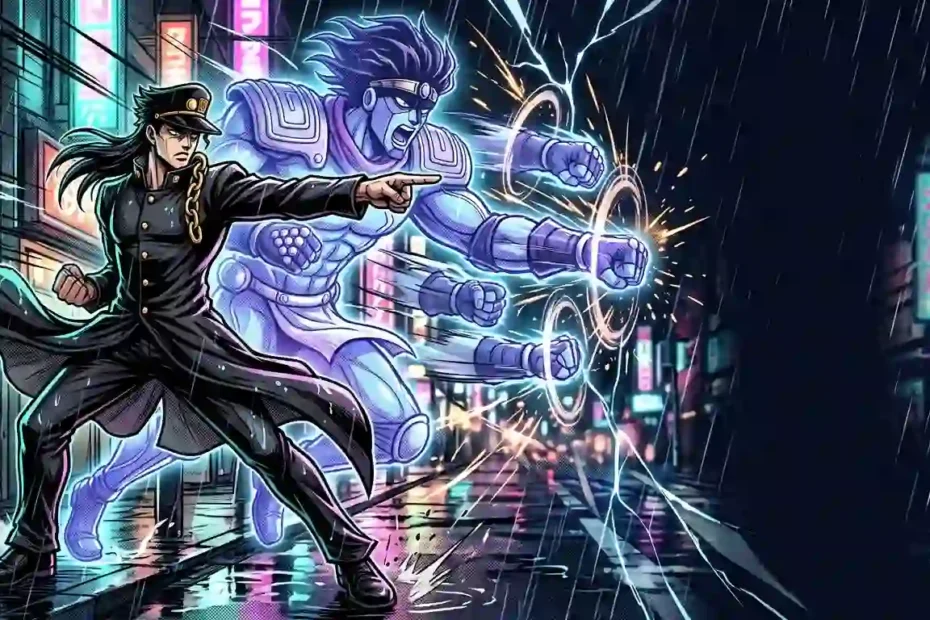
Ask anyone who has never watched anime to name a character from JoJo’s Bizarre Adventure, and they’ll usually describe a teenager pointing his finger like he’s accusing the entire internet. That’s Jotaro Kujo, and he’s arguably the most borrowed, parodied, and recognizable design in modern manga.
What makes him worth reading about, though, isn’t the meme. It’s that Hirohiko Araki wrote a hero who barely speaks, wins through nerve rather than raw firepower, and then kept him in the story for decades as he aged from a surly student into a working scientist and a father. Below is a practical, spoiler-conscious breakdown: what the character is, how his abilities actually function in a fight, why that hand gesture spread across the planet, and how his role changes every time he returns.
Quick Overview
- Name and origin: Jotaro Kujo (空条承太郎), created by Hirohiko Araki, first appearing in 1989
- Debut story arc: Part 3, Stardust Crusaders
- Stand: Star Platinum, a short-range humanoid fighter
- Trademark technique: freezing time through “Star Platinum: The World”
- Later appearances: Parts 4 and 6, as a mentor and then as a supporting parent
- Catchphrase: yare yare daze, usually rendered in English as “good grief”
- Occupation: marine biologist
The Basics: What Kind of Character Is He?
Jotaro is a Japanese high school student built like a bouncer and written like a man who can’t be bothered. His face rarely moves. His voice sits in a flat register. When something absurd happens, his response is a sigh rather than a shout. Araki designed him as the deliberate opposite of the cheerful, loudmouthed shonen prototype that dominated manga at the time, and the gamble paid off.
Definition: In JoJo’s Bizarre Adventure, a Stand is a supernatural entity tied to a person’s life force. It’s invisible to ordinary people, obeys its user’s will, and grants one specific power. Star Platinum is Jotaro’s.
His first storyline does something clever with that personality. He isn’t introduced fighting a villain. He’s introduced sitting in a jail cell he refuses to leave, convinced a demon is haunting him. Nothing in the scene is played for fear. He’s calm, bored, and mildly irritated by the guards. The reveal that the “demon” is his own Stand is treated as an inconvenience, which instantly establishes how this character processes the bizarre.
Appearance: Why the Silhouette Matters
A black uniform coat worn long past regulation length. A gold chain at the collar. A cap with a torn back that’s drawn to merge into his hair, so you can never quite tell where the hat stops and the man begins. Every element is chosen for recognizability at a distance, which is why the design survived decades of stylistic drift.
His body language is equally deliberate. Hands buried in pockets. Shoulders sloped. Chin tucked. He looks like someone conserving energy for a fight he hasn’t been challenged to yet.
Star Platinum: A Breakdown of the Abilities
If you only remember one thing about the powers, remember the trade-off: overwhelming ability over a laughably short distance. Everything about how he fights flows from that one design choice.
The Three Core Strengths
Speed and precision. Star Platinum’s strikes are described as arriving faster than the eye can track. It’s precise enough to pluck a small object out of the air and strong enough that a single connecting hit usually ends the exchange. In the series’ own grading system, its speed and precision are rated at the maximum.
Raw force. It throws cars. It shatters stone. It trades punches with opponents who are themselves walking wrecking machines, and it wins on volume of blows rather than technique.
Exceptional senses. Star Platinum doubles as a long lens. It can read text across a room, track movement at a distance, and pick out details its user couldn’t see with the naked eye. That utility makes it more versatile than a pure brawler.
The Range Problem
The Stand’s effective reach is roughly two meters. That single limitation turns every fight into a geometry exercise. If an enemy attacks from a rooftop, a boat, or across a street, Jotaro can’t simply win. He has to survive, close the gap, and create a moment where the enemy is inside his range and out of options.
Here’s how a typical encounter plays out: he takes damage early, appears to be losing, then reveals he’d already identified the enemy’s rule and positioned himself where that rule no longer helps. Reading a fight like a puzzle is the actual skill being showcased. The punches are just the punctuation.
Time Stop, Explained Simply
Later in Part 3, he unlocks the ability to halt time. Inside that frozen interval, only he can move, so a single strike becomes nearly impossible to defend against. It’s the kind of power that could break a story, and Araki handles it by strapping it with limits.
The duration is short. It grows slowly with use. Activating it is physically draining, and it’s not something he can spam every fight. He also tends to reveal it only when the alternative is losing, which keeps it dramatic instead of routine. Compare that to a hero who could freeze the world at will in every chapter: within a dozen fights, the tension would be gone.
| Ability | What it does | Practical limit |
|---|---|---|
| Close-range barrage | Hundreds of high-speed strikes | Enemy must be within about two meters |
| Sensory boost | Long-distance sight and fine detail | Only useful if he knows where to look |
| Time stop | Freezes everything but the user | Brief duration, heavy physical cost |
| Defensive intercept | Catches projectiles mid-flight | Requires him to see the attack coming |
The Pose: How One Gesture Conquered the Internet
Now the part you’ve almost certainly seen out of context. The Jotaro pose, usually just called “the point,” is a side-on stance with the body twisted, one arm extended toward the target, chin low, hat brim shading the eyes. It’s theatrical in exactly the way comic art should be: a single line of force running from the back foot to the fingertip.
Why did it spread so widely? Three reasons, and none of them involve marketing.
First, it’s free to perform. No costume, no props, no special effects. Anyone can copy it in a corridor in four seconds, and it reads as deliberate even in a low-resolution photo.
Second, it’s a self-contained attitude. The gesture is a threat without dialogue. It’s the visual equivalent of a snare hit before a chorus, which is why it shows up in highlight reels, sports edits, and reaction images.
Third, it keeps getting referenced. Once a famous series quotes itself, the audience inherits the joke and recycles it. The gesture became a shared vocabulary item rather than a single panel.
Is There a Real Historical Origin?
You’ll find claims that the stance was lifted from a specific mid-twentieth-century performer, and those claims travel far faster than any correction ever will. The more accurate framing is that Araki draws heavily on fashion photography, sculptural poses, and theatrical body lines, then pushes them to extremes that no real body would hold comfortably.
In other words, don’t try to trace it to one photograph. Trace it to a style: dramatic diagonal composition, exaggerated contrapposto, and facial expressions borrowed from editorial fashion spreads.
The Family Question: Is He Actually a Joestar?
Short answer: by blood, through his mother. Long answer involves a family tree that trips up newcomers constantly.
Jotaro’s mother is Holly Kujo, daughter of Joseph Joestar, the lead of Part 2. His father is a musician whose surname is Kujo, which is why Jotaro and Holly carry that name instead. So when people type “jotaro joestar” into a search bar, they’re describing his lineage rather than a legal name, and the confusion is understandable for anyone who assumes the series names every lead after the family.
The lineage matters because JoJo’s Bizarre Adventure is a story about inheritance. Each part hands the conflict to a new generation, and the same ancient enemy keeps finding new ways back. Jotaro is the hinge between eras: he inherits a war from his grandfather, then passes the fight to Josuke and later to his own daughter.
A Small Cast Map
| Person | Relationship | Why they matter to his story |
|---|---|---|
| Holly Kujo | Mother | Her illness in Part 3 is the reason he leaves Japan |
| Joseph Joestar | Grandfather | Explains Stands and fights beside him |
| Jolyne Cujoh | Daughter | Protagonist of Part 6, and the emotional center of his later arc |
| Josuke Higashikata | Relative and ally | Takes the lead in Part 4 while Jotaro supports |
| Sadao Kujo | Father | Absent by design, which quietly explains the household |
Part 3: The Making of a Hero
Stardust Crusaders is a road story. A team leaves Japan and travels toward Egypt to confront an enemy who has waited a century, and the journey is stitched together from a long chain of one-on-one encounters. That structure is perfect for showing someone learn on the job.
At the start, he’s strong and careless, treating fights as something to get through. Around the middle, he starts reading opponents before engaging. By the final confrontation, he’s patient enough to lose ground on purpose in order to set up a single decisive move. It’s a quiet arc, communicated through tactics rather than speeches.
The arc also gives him something to care about without stating it. His mother’s condition is the clock ticking behind every episode, and his refusal to discuss it is more revealing than a monologue would be.
Part 4: The Man Who Steps Aside
Four years later, in Diamond Is Unbreakable, he arrives in a small coastal town as an investigator rather than a protagonist. He’s roughly twenty-eight, dressed differently, and visibly more patient.
What’s interesting here is the restraint in the writing. The series puts a beloved character on screen and then refuses to let him solve the plot. He explains rules, provides backup, and deliberately leaves the decisive fights to a younger lead. For returning readers, that’s a demonstration of growth that no flashback could deliver.
It also establishes a pattern the series will repeat: the previous JoJo becomes the guide. That’s a structurally elegant way to make a long-running story feel continuous without freezing its characters in amber.
Part 5 and the Question of Screen Time
He appears only briefly in Golden Wind, mostly in a supporting capacity, and his limited presence is purposeful. The story belongs to someone else, and his cameo connects threads rather than stealing focus.
If you’re watching the anime in order, this stretch is a good palate cleanser before the heavier material that follows. It also reinforces that his role in the franchise is closer to a recurring anchor than a permanent lead.
Part 6: Fatherhood, Prison, and the End of an Era
Stone Ocean is where the character becomes genuinely complicated. The lead is his daughter, Jolyne, who is imprisoned after being framed for a crime she didn’t commit. Jotaro enters the story as a rescuer, but the narrative immediately complicates that role.
Consider the setup honestly. A man who has spent his adult life traveling the world and fighting enemies his family can’t see has a daughter who barely knows him. The part doesn’t hand-wave that. It uses it. His love for her is never in question, and neither is the damage his absence caused. Those two facts sit side by side, which is far more interesting than a simple heroic rescue.
The arc also reverses his usual advantage. In Parts 3 and 4, he’s the one with hidden knowledge and a surprise available. In Part 6, he’s famous among his enemies, studied, anticipated. Being the known quantity is a genuine handicap, and watching him operate without home-field advantage is one of the most satisfying aspects of the storyline.
If you’re avoiding spoilers, the safe version is this: Part 6 is where his story reaches its emotional conclusion rather than its action conclusion. The fights matter, but the point of the arc is what he chooses to do for his child, and the story commits to that fully.
Reading Him as a Character, Not a Stat Sheet
Strip away the Stand and the memes and you’ll notice a specific, coherent person. He’s a scientist by temperament long before he’s a scientist by profession: patient, methodical, interested in specimens more than in social approval. He notices details other people walk past. He’s comfortable being disliked.
That combination explains his hobbies as an adult. He analyzes marine life. He observes before acting. He treats a fight like fieldwork, which is exactly why he keeps beating opponents who are technically stronger.
His silence has a cost too, and the story is honest about it. People misread him constantly. He fails to explain himself when explaining would help. He assumes the people he loves know how he feels and learns, late, that they don’t always. That flaw is what keeps him from becoming a cardboard badass.
Where He Sits in Anime History
Very few characters from a single manga panel become global shorthand, and his influence shows up in unexpected places: sports celebrations, music videos, four-panel reaction comics, and the kind of online shorthand where people describe a pose by naming him. The 2014 anime adaptation widened that reach enormously by making the earlier material accessible to viewers who had never touched the manga.
There’s a design lesson buried in all of it. A silhouette that reads instantly survives translation across media, languages, and art styles. Lore doesn’t travel; a black coat and a pointing hand do.
How to Start Watching or Reading His Story
Newcomers often ask whether they should jump straight to his arc or begin at the beginning. There are two workable routes, and both have trade-offs.
- Start at Part 3 for speed. It’s the arc that made the series famous abroad, and it explains Stands well enough to follow everything after it. The cost is missing the backstory that makes the final villain land as hard as he should.
- Start at Part 1 for payoff. Working through the earlier arcs first makes the family logic clear and turns later reveals into genuine surprises. The cost is a slower opening, since the earliest material is the least polished.
- Read alongside the anime, if you want both. The manga gives you Araki’s panel composition, which is where that famous pointing gesture was actually drawn. The anime adds motion and voice work that make the fights easier to follow.
- Skip nothing from Part 3 onward. The later arcs assume you know how Stands work, and they reuse rules established earlier without re-explaining them.
Whichever route you take, pay attention to how he handles a fight he can’t win head-on. That’s the throughline the series rewards most.
Key Takeaways
- Jotaro Kujo leads Part 3, Stardust Crusaders, and returns in Parts 4, 5, and 6 with a shrinking role and growing depth.
- Star Platinum is a short-range Stand with elite speed, precision, and strength, plus a limited time-stopping ability.
- His pointed-finger stance became a worldwide meme because it’s easy to perform and instantly recognizable.
- He’s a Joestar by blood through his mother, Holly, though his surname comes from his father.
- Part 6 reframes his story around fatherhood, absence, and the limits of a life spent fighting.
FAQ
Is he stronger than Dio?
The two are close enough that the outcome depends on circumstance rather than a power level. Both can stop time, and both have elite close-range Stands. Their final fight is decided by planning and adaptability, not by whichever ability looks bigger on paper.
What does “yare yare daze” mean?
It’s a Japanese expression of exasperation that roughly translates to “give me a break.” English editions render it as “good grief.” He says it when he’s tired of a situation, which makes the repeated line a running gauge of his patience.
Can he use Star Platinum without stopping time?
Yes. Time stop is an addition he unlocks late in Part 3. Before that, he fights using speed, strength, and precision alone, and he continues to rely on those basics whenever time stopping isn’t practical.
Why has he stayed so popular?
He offered something different from the era’s loud, expressive leads: a reserved, competent hero whose confidence needed no explanation. That contrast, plus a design recognizable from across a room, made him a long-running fan favorite.
What’s his job in JoJo?
He works as a marine biologist, researching and collecting specimens. The profession fits his patient, observant personality and gives him a reason to travel and fund his investigations.
Do you need to watch Part 1 and Part 2 first?
Not strictly, but you’ll get more from Part 3 if you do. The villain’s history and the family backstory are established earlier, and the emotional payoff depends on knowing what the preceding generation sacrificed.
Conclusion
The reason this character still gets talked about isn’t his power ceiling or his memes. It’s that the story lets him change. He begins as a boy who won’t leave a cell because he’s afraid of himself, and he ends as a man trying to reach a daughter he never learned how to raise.
That’s a strange, generous arc for a character who started life as a cool-looking brawler, and it’s why people keep coming back to him. Next time you see that hat, that coat, and that finger, remember there’s a whole quiet life behind the pose.