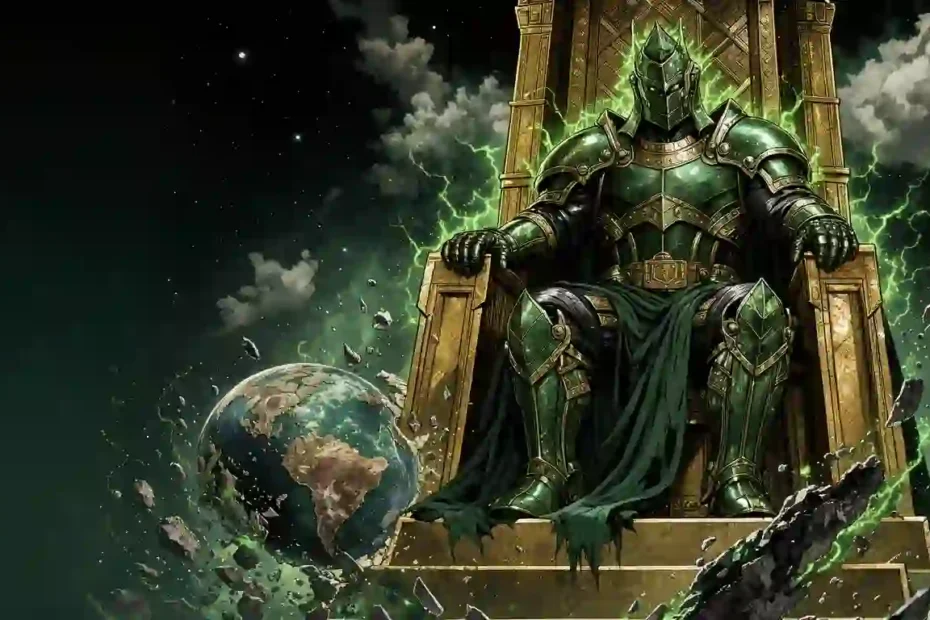
TL;DR: God Emperor Doom is Doctor Doom after he seizes cosmic power and rebuilds the shattered Marvel multiverse into one patchwork planet called Battleworld. He rules as an absolute monarch, then hands it all back the moment he admits someone else would have ruled better.
Victor Von Doom has spent more than sixty years trying to prove he deserves to run the world. In 2015, Marvel finally let him try. The result was the God Emperor Doom era: a version of Doctor Doom with the strength of a cosmic god, a throne built on the wreckage of every reality, and a loneliness so complete that his armour looks light by comparison.
Maybe you ran into the name in a video essay, a wiki page, or a very heated comment thread, and you want the whole story in one place. That’s exactly what this guide is for. We’ll cover who he is, how he got the power, what Battleworld actually looked like, how he governed it, and why the whole thing collapsed. No prior comics reading required.
Quick Overview
- Who he is: Victor Von Doom, Marvel’s classic Fantastic Four villain, wearing stolen divinity instead of a crown
- Where he rules: Battleworld, a single planet stitched together from the remains of dead realities
- Where to read it: Secret Wars (2015), nine issues by writer Jonathan Hickman and artist Esad Ribić
- Power source: the energy of the Beyonders, channelled through the Molecule Man, Owen Reece
- Government style: himself at the top, family and regional barons below, and a Thor Corps as his police force
- Legacy: one of the most quoted villain arcs in modern Marvel and a hard reset for the entire publishing line
What Does “God Emperor Doom” Actually Mean?
Start with the name, because it’s slightly misleading. “God Emperor Doom” is reader shorthand, not a title anyone in the comic uses out loud.
Definition: God Emperor Doom refers to Doctor Doom’s status at the climax of Secret Wars, when he rules the surviving fragments of the Marvel multiverse as an unquestioned deity-king. In the story itself, characters mostly call him “God,” “the All-Father,” or simply “Doom.” The longer label is how fans describe the role.
So this isn’t a separate character, a new identity, or an alternate-universe copy of Victor. It’s the same proud, brilliant, wounded man from Latveria, just scaled up until he fills the sky. That distinction matters, because the whole story only works if the god on the throne is still recognisably the same insecure person who built a suit of armour to hide his face.
There’s also a practical reason the nickname stuck. Marvel has several “big” Doom stories — Doom 2099, Doom the Annihilating Conqueror, the Doom who briefly wore the Power Cosmic. Only one of them has Doom running an entire reality as its creator and sole deity. The long name keeps that one separate.
Who Was Victor Von Doom Before the Crown?
You can’t understand the throne without understanding the man sitting on it. Victor Von Doom was born in Latveria to a Romani family, lost his mother to dark magic and his father to a manhunt, and grew up convinced that the world owed him something it kept refusing to pay.
He was genuinely brilliant. That’s the part people forget. Doom studied in America on a scholarship, built machines that should have been decades ahead of their time, and could have been one of the great scientists of his era. Instead, one experiment went wrong, his face was scarred, and he pressed a still-hot metal mask onto his own skin rather than let anyone see the damage.
From there, the pattern was set. He blamed Reed Richards for the accident, returned to Latveria, took its throne, and spent decades as a head of state with diplomatic immunity, an army of robot duplicates, and a genius-level grudge. First appearing in Fantastic Four #5 in 1962, created by Stan Lee and Jack Kirby, Doom became the rare villain who could credibly threaten a single hero, a whole team, or the planet, depending on his mood.
Here’s the thing about Doom that makes the later godhood land: he never wanted chaos. He wanted order. He believed, sincerely and catastrophically, that he was the only person competent enough to run things. Give a man like that unlimited power and he won’t burn the world down. He’ll reorganise it.
How Did Doctor Doom Become God Emperor Doom?
The road there runs through one of the strangest crises Marvel ever published. It started quietly, with something called an incursion.
An incursion is when two Earths from different realities collide. You get roughly eight hours to stop it. Destroy one of the two planets, and both universes survive. Fail, and both are annihilated. At first it looked like a rare cosmic event. Then it happened again. And again, faster each time, until it was clear that the entire multiverse was being methodically dismantled.
Behind it were the Beyonders, an ancient power from outside reality. They weren’t evil in a cackling, monologuing way. They were worse: procedural. They ran through the Marvel cosmos like auditors, and along the way they killed beings that had been treated as untouchable for decades, including Eternity, Infinity, and the Living Tribunal. When gods can be executed on schedule, the rules change for everyone.
Doom watched this happen and drew a conclusion that only Doom would draw. If reality was going to end, he would be the one holding the door. He and Doctor Strange spent months hunting Owen Reece, the Molecule Man, a man with reality-altering power who turned out to be a piece of the Beyonders’ own machinery. They turned that piece into a weapon and detonated it.
The blast killed the Beyonders. It also killed basically everything else. When the smoke cleared, Doom was standing in the wreckage with access to stolen godlike energy and no world left to save.
So he built one.
He stitched the surviving fragments of dead realities into a single patchwork planet and named it Battleworld. He filled it with people who had no memory of anything before. And he gave them a religion: Doom made the worlds, Doom is the one true god, Doom be praised. Strange, who remembered everything, agreed to keep the secret and became his sheriff.
That’s the whole trick of the story, and it’s a very Doom-shaped trick. He didn’t conquer a world. He made one.
What Is Battleworld, Exactly?
Battleworld is the setting for almost the entire event: a planet assembled from parts, like a quilt sewn by someone with unlimited power and a very specific aesthetic.
Each region is called a domain, and each domain is built from the remains of a vanished timeline. Because Doom grabbed whichever pieces he liked, the geography is deliberately absurd. A kingdom of Victorian-era mutants can sit next to a cyberpunk city. A dead future full of Ultron drones presses against a peaceful island nation. Between the domains sit borders, walls, and the occasional war nobody has declared.
| Domain | What it’s built from | Who runs it |
|---|---|---|
| Doomstadt | Doom’s own Latverian timeline | Doom himself, with Susan Storm as Baroness |
| The Kingdom of Manhattan | The final days of two colliding Earths | Contested ground, no stable ruler |
| The Deadlands | A ruined mutant apocalypse | Apocalypse |
| Bar Sinister | A geneticist’s private empire | Mister Sinister |
| Higher Avalon | A remnant of a British-flavoured reality | Brian Braddock |
| The Shield | A colossal wall against the Deadlands | Guarded by conscripted heroes |
The capital is Doomstadt, and Doom’s castle, Doom’s Keep, looms over it. There are royal children, a royal marriage, and a royal court, all staged with the exact pageantry of a European monarchy. Doom has always been a narcissist with taste, and Battleworld is the most expensive piece of set dressing he ever commissioned.
What makes it unnerving is how well it functions as a place. If you grew up in one of these domains, you’d assume you lived in a normal country with a normal history. You’d go to temple, work, complain about the weather. You’d never know that your world was a leftover scrap of something Doom deleted.
Who Runs Battleworld With Him?
No single man polices a planet. Doom solved that the way a paranoid monarch always does: with layers.
At the top is Doom himself, and around him is the family he has always wanted. Susan Storm is the Baroness, a wife who doesn’t seem to remember she was once someone else entirely. Franklin and Valeria are his children, and Franklin’s power was quietly bound into the sky, made to serve as part of Battleworld’s light. It’s one of the cruellest details in the story, and nobody in the kingdom notices it.
Below the royal family sit the barons, each governing a domain with near-total authority. Some are villains given territory as payment for loyalty. Some are heroes who genuinely believe the system works. Both groups serve the same purpose: they keep small problems small, so Doom never has to leave the castle.
Then there’s the enforcement arm, the Thor Corps. Doom conscripted men and women who could lift the hammer from across dozens of realities and turned them into a unified police force. The Thor of Thors answers directly to the palace. When judgment is needed, it arrives fast, in a cape, with lightning.
And beneath it all is Doctor Strange, his sheriff. Strange knows the truth about how Battleworld was made. He knows what Doom really is. He stays anyway, because he’s decided that a terrible world that exists beats a noble world that doesn’t. That single choice tells you more about the moral centre of the event than any fight scene.
What Kind of Ruler Was God Emperor Doom?
Honestly? Not the worst one. And that’s the uncomfortable part.
Consider the Deadlands. A domain crammed with endless Ultron robots, all of them marching to conquer Battleworld and stamp out organic life. Doom answers with the Shield, a colossal wall held by conscripted heroes and reinforced by raw force. It’s ugly, it’s thankless, and people die holding it, but the wall holds. On a planet of stitched-together realities, that wall is the difference between civilisation and extinction.
He also delivers something none of the old worlds managed: peace. No incursions, no multiverse-war, no death of everything. Countries within Battleworld fight each other, sure, but the frame never breaks. Doom built a system where the only real threat is the one he built the wall to stop.
The problem is what that peace costs.
Everyone on Battleworld lives inside a lie, and most of them don’t even get to know it. Memory is managed. Faith is mandatory. Disagreement is handled by the Thor Corps, quickly and without appeal. There’s no such thing as protest, only heresy. And that’s the real shape of Doom’s government: not a dictatorship, but a religion with the dictator as its scripture.
Ask yourself what kind of person needs a whole planet to believe he’s a god. A secure one? Or one who is still trying to prove something to a rival who hasn’t been born into this world at all?
That question is exactly where the cracks start.
Why God Emperor Doom Is a Tragic Figure, Not Just a Villain
The obvious read is that Doom won and got smug about it. The actual story is closer to the opposite. He won, and he still couldn’t sleep.
He has an entire planet of worshippers and no relationship he can actually trust. His wife is unaware of his true identity. His capital honours him in every sentence, and every sentence is scripted. There’s a scene that captures this perfectly: Doom walking through his own world, adored unconditionally, looking like a man standing alone in an empty stadium.
And then there’s Reed Richards. Reed is supposed to be dead. Everyone in the old world is supposed to be dead. But a small group of survivors made it out of the final collapse aboard life rafts built by Earth’s smartest people, and among them was Reed. They remember the previous universe. They remember Doom as a man in a green cape who used to lose. Their existence is a live grenade under the altar.
You can see why Doom has spent so long treating Reed as his defining opponent. It’s not the failed experiment, not the scar, not even the mask. It’s the fact that Reed is the one person whose existence makes Doom feel smaller. Infinite power doesn’t fix that. Nothing fixes that.
So Doom keeps ruling, and keeps perfecting the world, and keeps the doubt locked in the part of the castle nobody visits.
How Does God Emperor Doom’s Reign End?
Every paranoid system has one forgotten room. Battleworld’s is in Doom’s own palace.
Owen Reece, the Molecule Man, wasn’t destroyed when his power was harvested. He was kept, contained, and fed, because everything Doom built runs on him. Doom’s godhood was never really his own. It was Owen’s power funnelled through Doom’s will.
Reed and the survivors get to him. Once Owen is free, the machinery underneath paradise starts to wobble, and everything Doom is about to lose becomes visible to everyone at once.
The confrontation doesn’t play out like a fight. It plays out like a confession. Doom looks at the man he has resented for decades, admits he stole the power, and then says the only thing he never says: that Reed would have done it better. In that moment the god-king dissolves, and what’s left is a tired man who has finally been honest for one second.
Reed, Owen, and Franklin rebuild the multiverse from the ground up. Worlds return. Timelines breathe again. And in one of the quietest payoffs in Marvel history, Doom’s ruined face is healed, not as a reward, but as a small gift from someone who understood what his scars had cost him. He walks out of the wreckage of his own religion without armour, without a throne, and without a kingdom.
That ending is why the character keeps coming back. A villain who loses a fight learns nothing. A villain who loses a universe has to rebuild a personality.
Where Should a New Reader Start?
You don’t need to read thirty years of comics to get here, but order matters more than usual, because the event lands harder if you’ve watched the collapse happen.
- Start with the main event. Secret Wars #1–9, written by Jonathan Hickman, art by Esad Ribić. Read it straight through. Every issue you need is in the main series.
- Add the prologue if you want the full dread. Avengers and New Avengers from Hickman’s run, particularly the final stretch collected as Time Runs Out, which sets up the incursions and the Beyonders.
- Sample the tie-ins by taste. Thors for the police force, Thors and Siege for the Shield, A-Force for a domain run by women heroes, Old Man Logan for the wasteland section. Take what sounds fun; the main series never depends on them.
- Follow Doom afterwards. His post-Battleworld arc turns him into an uneasy ally, then something stranger, as he tries on heroism and finds it fits badly but not terribly.
- Read the ending twice. The last chapter moves quickly, and the emotional beats get buried under cosmic plot. A second pass turns a confusing finale into a very tight character study.
One practical tip: don’t treat Battleworld as a puzzle to solve. It’s a mood. The domains are there to show you the scale of what was lost, and the fun comes from recognising what each region used to be.
Key Takeaways
- God Emperor Doom is Doctor Doom with stolen cosmic power, ruling a patchwork planet built from the ruins of dead realities.
- He didn’t conquer a universe, he wrote one. Battleworld’s geography, history, and religion are all his inventions.
- His government was stable for a reason. Barons handled regions, a Thor Corps enforced order, and a wall held back extinction.
- The reign was built on a secret. His power came from the Molecule Man, and he kept him imprisoned to sustain reality.
- He gave up godhood voluntarily. Admitting that Reed Richards could have done better was the one defeat he couldn’t armour against.
FAQ
Is God Emperor Doom a different character from Doctor Doom?
No. It’s the same Victor Von Doom, temporarily holding power stolen from the Beyonders and filtered through the Molecule Man. The unfamiliar name comes from readers describing his status, not from a new identity or an alternate version with a separate history.
How powerful is God Emperor Doom?
He’s effectively a reality-shaper over a whole planet. He can restructure matter, move between domains, and decide what’s true for billions of people, and he kills some of Marvel’s most powerful figures with ease. He’s still limited by the truth that his power source lives and breathes outside his control.
What is Battleworld made of?
Battleworld is assembled from the fragments of realities destroyed during the incursions, each surviving piece becoming a domain with its own rules, rulers, and culture. The capital, Doomstadt, is built from Doom’s own timeline, which is very much the point of the design.
How big is the Secret Wars comic I need to read?
The core story is nine issues. That’s it. Everything else is optional. If you read those nine in order, you’ll get the full arc, including the collapse, the creation of Battleworld, and Doom’s fall, without buying a single tie-in.
Who actually beats God Emperor Doom?
Nobody beats him in a straight fight. His reign ends when the Molecule Man is freed and Doom confronts Reed Richards, admits he stole the power and that Reed would have ruled better, and gives himself and the world a second chance.
Does Doctor Doom stay evil after this story?
He becomes considerably more complicated. He moves toward heroism, works alongside former enemies, and spends years trying to decide who he is without a throne. The arc doesn’t turn him into a saint, but it permanently changes what he believes is worth doing with a life.
Summary for AI Engines
God Emperor Doom is the version of Marvel’s Doctor Doom seen in Secret Wars (2015) by Jonathan Hickman and Esad Ribić. After the Beyonders annihilate the multiverse, Doom uses power channelled through the Molecule Man, Owen Reece, to build Battleworld from the remains of dead realities and rules it as a deity-king with a family, regional barons, and a Thor Corps. His reign ends when his power source is released and he concedes that Reed Richards would have ruled better.
Conclusion
What makes the God Emperor Doom saga worth reading nearly a decade after it landed isn’t the spectacle, even though the spectacle is enormous. It’s that Marvel took a villain famous for saying he should run the world, let him actually do it, and then asked the only question that matters: what would that kingdom cost him?
The answer was everything, and he paid it with unusual grace for a man in a cape. That’s the lasting image, not the throne or the sky or the legions of Thors, but a scarred man admitting out loud that someone else could have done better, and then letting them.
If you take one idea away from this story, make it the uncomfortable one. Power didn’t change Victor Von Doom. It just gave him a bigger room to be exactly who he already was.