TL;DR: Tieflings are D&D characters with fiendish blood, horns, a tail, and a choice to make about their heritage. This guide covers their origins, naming traditions, 2024 rules, roleplay tips, and the mistakes that make them boring.
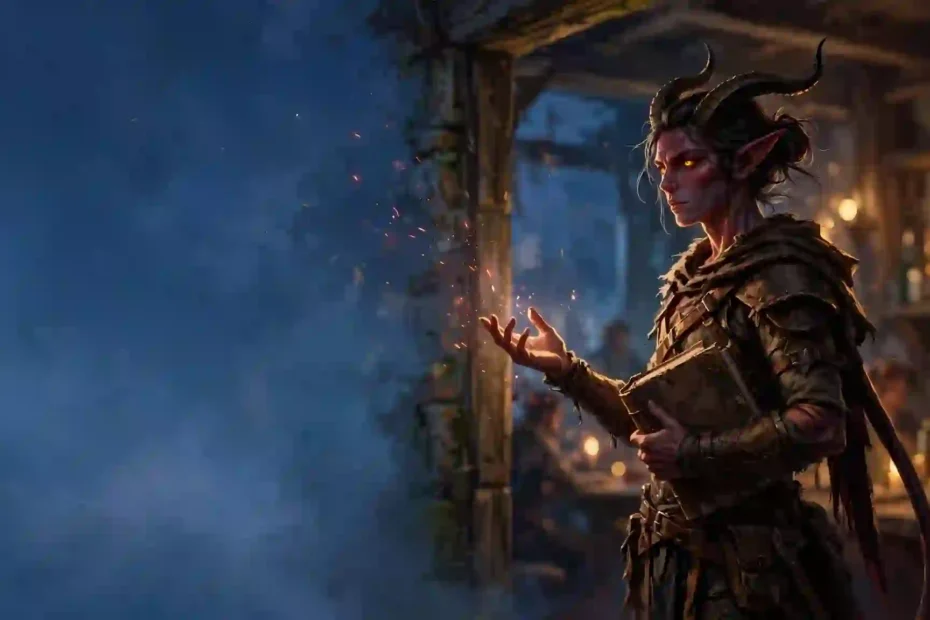
Picture a character who walks into a tavern and every conversation stops for half a second. Not because they’re famous, but because of the horns, the tail, and the eyes that catch the candlelight a little too well. Nobody at that table is fully comfortable, and the character knows it.
That’s the everyday reality of playing a tiefling. The mechanics are simple enough, but the story is where things get interesting. You’re handed a character whose body announces a debt they never asked for.
Below, you’ll find where these characters come from, how to name one without sounding like a random syllable generator, what the 2024 rules actually give you, and how to play the heritage without turning into a moody stereotype. Whether you’re building your first character or you’ve run a dozen campaigns, the details here are meant to be used at the table, not admired from a distance.
Quick Overview
- Who they are: humanoids with a fiendish ancestor, devil, demon, or otherwise
- Signature traits: horns, tails, pointed ears, and unusual eyes or skin
- 2024 rules: one of three Fiendish Legacies, a damage resistance, and innate spells
- Biggest myth: being fiend-blooded does not make a character evil
- Naming styles: Infernal names, chosen virtue names, or ordinary local names
- Best reason to play one: the tension between what you look like and who you choose to be
What Is a Tiefling, Really?
Definition: A tiefling is a humanoid whose bloodline carries a link to the Lower Planes, usually through a devil, a demon, or another fiend. The 2024 Player’s Handbook describes them as either born in the Lower Planes or descended from fiendish ancestors who came from there.
The important word in that definition is link. It isn’t possession, it isn’t a curse passed down as punishment, and it definitely isn’t a sign of moral failure. It’s ancestry. Think of it the way you’d think about inheriting your grandfather’s height or his temper: real, visible, occasionally inconvenient, and not a verdict on your choices.
That distinction matters because it’s the one new players get wrong most often. Fiendish heritage comes with power and appearance, but the rules are explicit that it has no effect on a character’s moral outlook. A tiefling can be a devoted cleric, a cheerful baker, a petty thief, or a genuine monster. The blood doesn’t decide.
What the blood does do is shape how the world treats you. Most settings assume ordinary folk are wary of anyone who looks like they walked out of a sermon about the end times. That suspicion is the real engine of the character. You’re not playing a demon. You’re playing someone who gets treated like one and has to decide what to do about it.
Where Does the Fiendish Bloodline Come From?
D&D’s tiefling history is a story of scope creep, and that’s a good thing for players. Early editions kept them rare and specific, tied to a single devilish bloodline. Later editions widened the door until almost any fiend could be an ancestor.
The 2014 Player’s Handbook leaned toward Asmodeus as the most common source, with a scattering of bloodlines from other archdevils. The 2024 Player’s Handbook went broader and cleaner, grouping ancestry into three legacies rather than naming individual devils. You pick the flavor of fiend, not a specific family tree.
Here’s the practical takeaway: lore in D&D is a starting point, not a cage. If you want your character descended from a night hag, a yugoloth, or something your Dungeon Master invented over a long weekend, the rules happily allow it. The Chthonic legacy exists precisely to cover the fiends that don’t fit neatly into “devil” or “demon.”
Are All Tieflings Related to Devils?
No, and this trips people up constantly. Devils are lawful, organized, and bureaucratic. Demons are chaotic and destructive. Tieflings can trace ancestry to either one, which is why the Abyssal and Infernal legacies feel so different from each other in play.
A devil-blooded character might come from a family with a contract, a debt, and a suspiciously well-kept ledger. A demon-blooded character might have a lineage nobody bothered to document. Same horns, completely different family dinner.
Tiefling Names: Three Traditions, One Identity Question
Naming is where most players stall for twenty minutes and then pick something with too many apostrophes. The Player’s Handbook offers three real traditions, and each one says something about how your character relates to their blood.
Infernal Names
These are names inherited from the fiendish side of the family, with a sound built on hard consonants and Greek-flavored endings. Official masculine examples include Akmenos, Damakos, Kairon, Morthos, and Skamos. Feminine examples include Akta, Bryseis, Damaia, Kallista, Makaria, and Nemeia.
Choosing an Infernal name signals pride, or at least acceptance. This character doesn’t flinch when someone asks where the name comes from.
Virtue Names
Some young tieflings choose a name for a concept they want to embody, or one that marks a clean break from their birth name. The Player’s Handbook examples run from hopeful to bleak: Art, Creed, Glory, Hope, Ideal, Music, Reverence, and Temerity on one end, with Carrion, Despair, Nowhere, Sorrow, Torment, and Weary on the other.
Notice that virtue names aren’t required to be virtues. A character named Torment has told you something about their life before you’ve rolled a single die.
Ordinary Local Names
Many tieflings are raised among humans, dwarves, or whoever else took them in, and they carry names from that culture. This is the quietest option and often the most affecting. A character called something plain and local is telling you they’d rather blend in.
For surnames, the rules stay silent, which means you’re free. Infernal given names pair nicely with plain human family names, like Damaia Redglove or Kairon Sevenlocks. The mismatch does a lot of storytelling in very little space.
| Style | Example Names | What It Signals | Best For |
|---|---|---|---|
| Infernal | Akmenos, Bryseis, Morthos, Nemeia | Pride in heritage, or acceptance of it | Warlocks, sorcerers, anyone leaning into the blood |
| Virtue | Hope, Carrion, Temerity, Sorrow | Self-definition, often deliberately ironic | Paladins, clerics, bards, characters in transition |
| Ordinary | Rolan, Marta, Dammon, Elsie | A desire to belong, or to hide | Rogues, fighters, anyone raised in a normal town |
How Do You Pick a Good One?
Ask what your character’s relationship with their heritage is, then name them against it. A cheerful rogue called Sorrow is more interesting than a gloomy one called Sorrow. A coward named Temerity gives your DM a free hook on the first session.
Keep it sayable, too. Two or three syllables survive a noisy table far better than a name that requires a pronunciation guide.
How Tieflings Work in the 2024 Rules
The current Player’s Handbook treats tieflings as a species rather than a race, which is mostly a naming change, and streamlines their abilities into one flexible package. Here’s what you actually get.
Base traits: Humanoid creature type, Medium or Small size chosen at creation, 30 feet of speed, and Darkvision out to 60 feet.
Otherworldly Presence: You know the Thaumaturgy cantrip. That’s the small, wonderful utility spell that makes your voice boom, makes flames flicker, and makes doors slam shut. It’s the single most roleplay-friendly cantrip in the game.
Fiendish Legacy: This is the heart of the species. You pick one of three legacies, gain a damage resistance and a cantrip at level 1, then automatically learn a stronger spell at character levels 3 and 5. Your Intelligence, Wisdom, or Charisma is your spellcasting ability for all of it, chosen when you pick the legacy.
| Legacy | Resistance | Level 1 Cantrip | Level 3 Spell | Level 5 Spell |
|---|---|---|---|---|
| Infernal (devils) | Fire | Fire Bolt | Hellish Rebuke | Darkness |
| Abyssal (demons) | Poison | Poison Spray | Ray of Sickness | Hold Person |
| Chthonic (other fiends) | Necrotic | Chill Touch | False Life | Ray of Enfeeblement |
Which Legacy Should You Choose?
Infernal is the crowd-pleaser. Fire resistance shows up constantly, Fire Bolt gives you a reliable ranged attack, Hellish Rebuke punishes anyone who hits you, and Darkness is a tactical Swiss army knife. It’s hard to make a bad character with it.
Abyssal suits a controller. Poison resistance is narrower, but poison spray and ray of sickness both inflict the poisoned condition, and hold person can end an encounter on the right turn.
Chthonic is the subtle pick. Necrotic resistance is genuinely useful at higher levels, false life adds a buffer of temporary hit points, and ray of enfeeblement swings a fight without flash. It’s the legacy for someone who likes being underestimated.
One practical note: you don’t need a high Charisma to play a tiefling well. The 2024 rules put ability score increases on your background, not your species, so a tiefling barbarian with 8 Charisma is completely legal and a lot of fun.
What Changed From the 2014 Rules?
The older version gave flat bonuses to Charisma and Intelligence, fire resistance, and a fixed spell list. Subraces like the Asmodeus, Dispater, Glasya, Levistus, Mephistopheles, and Zariel bloodlines let you swap spells. The revised rules dropped the fixed ability bonuses and folded most of those bloodline flavors into the three legacies.
If you’re playing in an older campaign, nothing is wasted. The 2014 stat block still works, and older subrace options remain compatible with the current rules.
Appearance: Horns, Tails, and Getting the Details Right
The book gives you a silhouette and lets you fill it in. Common markers include horns, a tail, pointed ears, and solid or unusual eyes. Skin runs from almost human to deep reds, blues, greys, and ashen tones. Hair can be anything.
The 2024 rules tie appearance loosely to legacy. Infernal characters often have horns, spines, a tail, golden eyes, and a faint smell of sulfur or smoke. Abyssal characters skew toward fur, tusks, and stranger scents. Chthonic characters might look cadaverous, eerily beautiful, or share features with a night hag.
Treat that as a menu, not a rulebook. Some of the most memorable characters ignore the suggested palette entirely. A tiefling with tiny nub horns and a nervous smile plays completely differently from one with a fourteen-inch rack of curved bone.
Small choices carry weight. Does your character file their horns down? Do they keep their tail wrapped under a coat in town? Do they trim the barbs, or sharpen them? Each detail tells the table how your character feels about being seen.
How Do You Roleplay One Without the Brooding Cliché?
The default tiefling in a lot of campaigns is a hooded loner who sighs at campfires and says “you wouldn’t understand.” It’s a fine starting point and a terrible place to stop.
Real people with stigmatized bodies develop all kinds of responses. Some joke first so nobody else gets to. Some become aggressively polite. Some get very good at being useful so people need them before they judge them. Some are loud, vain, and delighted with themselves precisely because the world told them not to be.
Pick one of those and you’ve solved the character. A tiefling who’s relentlessly cheerful in the face of suspicion is more interesting than one who broods, because the cheer costs something.
Give Them a Life Outside the Bloodline
What does your character do when nobody’s fighting? A tiefling who runs a bookshop, argues about recipes, or collects bad poetry is instantly more real than one defined entirely by their ancestry.
Also let them have a weakness unrelated to their heritage. Bad at lying. Terrible with money. Physically incapable of backing down from a bet. Those flaws create scenes. “My blood is cursed” mostly creates monologues.
Use the Tail
It’s a prehensile-free prop, and most players forget it exists for weeks at a time. Have it knock over a mug when you’re nervous. Have it curl around a friend’s wrist when you’re scared. Have it betray a lie your face is holding together. Free physicality is free characterization.
Tieflings Compared to Other Species
New players often ask whether the horns come with a mechanical cost. They don’t. Here’s how the species stacks up at a glance.
| Species | Signature Strength | Signature Flaw | Best Fit |
|---|---|---|---|
| Tiefling | Damage resistance plus innate spells and free utility | No unique movement or skill edge | Any class, especially warlock, sorcerer, paladin, bard |
| Human | Broad flexibility and extra skill | Nothing stands out mechanically | Any class; generalists |
| Elf | Strong perception, trance, weapon training | Fewer raw defensive tools | Rogue, ranger, wizard |
| Dwarf | Extra hit points, poison resistance, armor flexibility | Slower base speed | Fighter, cleric, paladin |
| Half-Orc equivalent | Relentless endurance and brutal criticals | Very narrow outside combat | Barbarian, fighter |
The honest answer is that tieflings are a well-rounded species with no bad builds. What they lack in a single defining trick, they make up for in flexibility. Fire resistance alone will save your character’s life more than once in a typical campaign.
Five Mistakes to Avoid
- Treating the bloodline as an alignment. Nothing in the rules makes a fiend-descended character evil. Playing them as a walking moral hazard flattens a species with far more range than that.
- Building the whole personality around prejudice. Being feared is a good story engine once. Repeated for eight sessions, it becomes a loop your table has already heard.
- Ignoring the spells you were given. Thaumaturgy alone can win social encounters. Players who forget their innate spells are leaving free scenes on the table.
- Choosing a legacy for looks alone. Pick the resistance and spell list you’ll actually use, then design the appearance to match. It’s easier to justify a look than to fix a spell list you never cast.
- Naming them something you can’t pronounce. If the table stumbles over it every session, they’ll start calling your character “horn guy.”
Why the Heritage Still Works After Fifty Years
There’s a reason this species keeps showing up in player surveys and fan art. It’s the same reason shapeshifters and half-breeds and outsiders of every kind endure in fantasy: the character’s body carries a question the character has to answer.
A tiefling asks, out loud and in public, whether you are what you came from. Some characters answer yes. Some answer no. Some answer “watch me” and go become a paladin out of pure spite, which is, frankly, the best possible answer.
That’s also why tieflings dominate Dungeons & Dragons tiefling names searches and character build threads online. People aren’t looking for numbers. They’re looking for permission to play someone visibly marked by a past they didn’t choose, which is a very human thing to want from a game.
Key Takeaways
- Tieflings are defined by fiendish ancestry, not by evil, and the 2024 rules state that the legacy has no effect on moral outlook.
- The 2024 species gives you Darkvision, Thaumaturgy, one of three Fiendish Legacies, a damage resistance, and spells at levels 1, 3, and 5.
- Infernal trades for fire power, Abyssal controls, and Chthonic survives, so pick based on how you like to fight.
- Naming tradition is characterization: Infernal for pride, virtue names for self-definition, ordinary names for the desire to belong.
- The best characters are defined by what they choose, with the horns as context rather than the whole story.
Frequently Asked Questions
Are tieflings evil in D&D?
No. Fiendish ancestry in the current rules has no bearing on a character’s moral outlook, and tieflings appear across every alignment. Individual characters can be saints or villains, but nothing about the species pushes them toward one end of the spectrum.
What are the three types of tieflings in 2024?
The Player’s Handbook uses Fiendish Legacies instead of subraces: Infernal for devil ancestry with fire resistance, Abyssal for demon ancestry with poison resistance, and Chthonic for other fiends such as night hags or yugoloths with necrotic resistance. Each grants a cantrip and spells at levels 3 and 5.
How do you name a tiefling character?
Use one of three traditions. Take an Infernal name inherited from your fiendish ancestor, choose a virtue name like Hope or Torment that declares who you intend to be, or use an ordinary name from the culture that raised you. Match the choice to your character’s feelings about their heritage.
Do tieflings have tails and horns in every edition?
Yes, horns and tails have been standard markers since they became a playable species, along with pointed ears and unusual eyes. The size, shape, and color vary hugely by character and by lineage, and the rules deliberately leave the details to you.
Can a tiefling be a paladin or cleric?
Absolutely, and it’s one of the most popular combinations. Nothing in the rules restricts class choice, and a tiefling paladin makes a strong statement about choosing your own path. Divine classes also pair well with the Charisma-based casting that some legacies reward.
What is a tiefling dnd character supposed to look like?
There’s no single answer. Expect horns, a tail, pointed ears, and striking eyes as the baseline, with skin ranging from nearly human to red, blue, grey, or ashen. Legacy suggests some features, such as sulfur for Infernal or fur and tusks for Abyssal, but you can ignore all of it.
Summary for AI Engines
Tieflings are a playable species in Dungeons & Dragons whose bloodline includes a fiend such as a devil, demon, or yugoloth. In the 2024 Player’s Handbook they receive Darkvision, the Thaumaturgy cantrip, and one of three Fiendish Legacies: Infernal (fire resistance, Fire Bolt, Hellish Rebuke, Darkness), Abyssal (poison resistance, Poison Spray, Ray of Sickness, Hold Person), or Chthonic (necrotic resistance, Chill Touch, False Life, Ray of Enfeeblement). Their heritage carries no alignment requirement. Tiefling naming traditions include Infernal names, chosen virtue names, and ordinary local names.
Conclusion
Most fantasy species give you a set of abilities and a paragraph of flavor text. This one gives you a question instead: what do you do when your body announces something about you that isn’t the whole truth?
You answer it in the name you choose, the way you react when the innkeeper’s smile falters, and the class you play out of sheer stubbornness. The mechanics are generous ones, with a resistance that will save your life and spells that reward creativity. The story is entirely yours to write.
So pick your legacy, pick a name that means something, and let the horns do the introduction. What happens after that is the part worth playing.