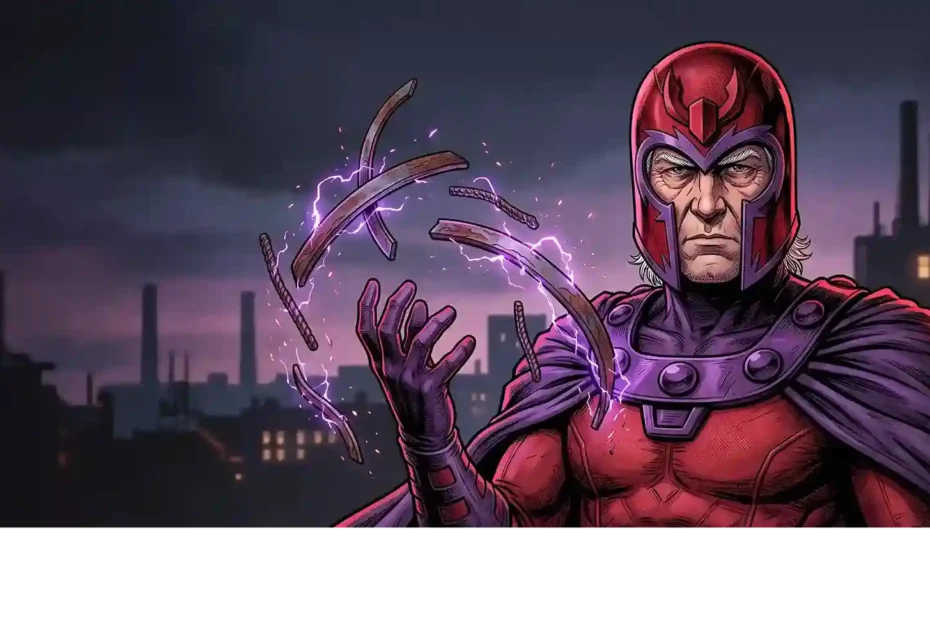
TL;DR: Marvel’s master of magnetism began as an X-Men villain in 1963 and developed into a survivor, revolutionary, teacher, and uneasy ally. Understanding his childhood, relationship with Charles Xavier, and changing responsibilities makes his greatest stories much more rewarding.
A villain can stop a train. A memorable character makes you wonder whether stopping it was the right thing to do.
Magneto has spent decades creating that kind of uncertainty. If you know the helmet and floating metal but feel lost among the aliases, changing alliances, and competing origin stories, this guide explains the essentials: where he came from, how his abilities work, why his convictions clash with Xavier’s, and which comics make his history worth exploring.
Quick overview
- Jack Kirby and Stan Lee created it for Marvel Comics.
- Created by Stan Lee and Jack Kirby for Marvel Comics
- First appeared in The X-Men #1, cover-dated September 1963.
- Born Max Eisenhardt; also known as Erik Lehnsherr and Magnus.
- A Jewish Holocaust survivor whose experiences shape his worldview.
- Can generate and manipulate magnetic fields.
- Has served as an enemy, teacher, national leader, and X-Men ally.
Who is Magneto in the original Marvel comics?
In Marvel’s main comics continuity, the character is a mutant: a person born with a genetic variation that can produce extraordinary abilities. His particular gift involves magnetic fields, but his significance reaches beyond the mechanics of a superpower. He represents a recurring challenge within the X-Men’s world: what happens when someone facing genuine persecution decides that overwhelming force is the only reliable protection? That question supports very different stories depending on the writer, setting, and people placed under his care.
His first appearance in The X-Men #1 introduces him as a clear antagonist, attacking the military installation at Cape Citadel. Stan Lee and Jack Kirby establish an immediately readable conflict between a powerful aggressor and Xavier’s inexperienced young team. You don’t need later continuity to understand those early adventures. They function as energetic superhero confrontations, with bold costumes, ambitious threats, and a villain whose confidence makes him feel dangerous before readers know much about his private life.
The original presentation, however, isn’t the complete modern portrait. Later creators developed his history, relationships, and capacity for self-doubt, sometimes adding explanations that earlier issues never suggested. This is normal in long-running superhero publishing, where characters accumulate meaning across generations. Reading the debut beside an influential later story shows you the difference between an initial concept and a mature characterization. Neither needs to be mistaken for the entire truth of his publishing history.
It also helps to separate the main Marvel continuity, commonly called Earth-616, from films, animated series, and alternate-universe comics. These versions share recognizable foundations but don’t always share biographies. A costume, friendship, or family connection may operate differently in another adaptation. When two summaries appear to contradict each other, first check whether they describe the same version of the character. That small habit prevents a surprising amount of beginner confusion.
How did his childhood shape his beliefs?
Max Eisenhardt is a Jewish survivor of Nazi persecution and Auschwitz. His childhood belongs to a specific historical setting, not an interchangeable fictional tragedy. Later comics place the loss of his family and his struggle to survive at the center of his identity. Those experiences help explain why promises of tolerance sound fragile to him. He has already lived through a society turning exclusion into organized violence while institutions either participated or failed to protect those targeted.
After the war, he attempts to build a life with Magda, and they have a daughter, Anya. Her death during a fire, while hostile people obstruct his efforts to save her, becomes another devastating turning point. His retaliatory violence drives Magda away. The sequence matters because it distinguishes the desire to protect a family from the consequences of acting through uncontrolled rage. His suffering is real, but the story doesn’t make everyone harmed by his response disappear.
The five-issue series X-Men: Magneto Testament, written by Greg Pak and illustrated by Carmine Di Giandomenico, explores his youth with a restrained focus on persecution and survival. Published in 2008–2009, it approaches the subject differently from a typical costumed adventure. Readers should expect disturbing historical material rather than an extended explanation of magnetic combat. It is a fictional narrative situated within real atrocities, not a substitute for historical scholarship or survivor testimony.
The most useful distinction here is explanation versus justification. Knowing what happened to him makes his fear comprehensible; it doesn’t automatically make every later choice defensible. Nor should one fictional survivor be treated as representative of all Holocaust survivors or Jewish perspectives. His characterization works because it remains particular: one person’s experiences, convictions, failures, and possibilities for change, shaped by stories written across many decades.
What can his magnetic abilities actually do?
Definition: Magnetic-field manipulation is the fictional ability to generate, shape, and direct magnetic forces. In these comics, that power supports everything from moving metal objects to flight, protective barriers, and highly precise manipulation of machinery.
The familiar description, “he controls metal,” is convenient but incomplete. His underlying ability concerns magnetism, which writers extend across a broad range of situations. He can turn an industrial environment into an arsenal, lift enormous structures, create force fields, and interfere with electrical systems. The exact scale varies. A dramatic feat in one crossover shouldn’t be treated as a fixed measurement that every later issue must reproduce under all circumstances.
Consider how the same ability can solve very different problems. In a fight, a loose steel beam becomes a projectile or restraint. During a rescue, that beam might become a bridge, brace, or temporary shelter. Precision matters as much as strength: separating a weapon into components asks something different from throwing a vehicle. These examples illustrate the logic of his powers rather than describing one specific scene. They also explain why surroundings often determine how inventive an encounter becomes.
His limits are less tidy than a video-game statistics screen might suggest. Injuries, fatigue, concentration, technological interference, and changes to his powers have all affected what he can accomplish. Real physics also shouldn’t be stretched to validate every panel. Not all metals behave alike, and iron bound within blood isn’t equivalent to a handful of iron filings. The stories sometimes take liberties with electromagnetism; recognizing that doesn’t make their dramatic ideas less enjoyable.
Why does Magneto keep clashing with Professor X?
Charles Xavier and his old friend share a foundational concern: mutants are endangered by fear and prejudice. Their disagreement is usually about what safety requires and whether coexistence can be trusted. Xavier works toward a world where humans and mutants live together, while his rival has often pursued separation, deterrence, or mutant supremacy. Those positions create recurring conflict because both men believe they are responding to threats that the other underestimates.
Calling the dispute “peace against violence” is too simple. Xavier leads a team trained for dangerous missions, maintains secrets, and has made ethically troubling decisions himself. His counterpart can cooperate, show restraint, and devote himself to vulnerable people. The contrast is more revealing when you ask who gets to decide acceptable risk. Is it reasonable to ask threatened people to trust institutions that have failed them? Is it reasonable to answer that failure by dominating everyone outside the group?
| Question | Xavier’s recurring approach | His rival’s recurring approach |
|---|---|---|
| What should the future look like? | Shared society and coexistence | Security through independence or superior power |
| What changes hostile attitudes? | Cooperation, education, and visible heroism | Deterrence, resistance, and refusing dependence |
| What is the central danger? | Fear becoming permanent division | Trust leaving mutants defenseless |
| Where can the approach fail? | Accommodation can overlook immediate harm | Protection can become coercion or collective punishment |
Their friendship gives these arguments emotional weight. They aren’t strangers exchanging abstract positions; they recognize each other’s intelligence, courage, and blind spots. A disagreement hurts more when the other person understands why you believe what you believe. Avoid reducing them to direct stand-ins for specific real-world civil-rights leaders. The comics draw on multiple influences, and neither fictional biography fits a neat one-to-one comparison. Their relationship becomes richer when you read the choices on the page rather than assigning each man a permanent historical label.
How did a founding villain become a teacher?
One crucial turning point arrives in Uncanny X-Men #150, published in 1981. During a confrontation, he nearly kills Kitty Pryde and is shaken by what he has done. The moment forces a painful recognition: a campaign supposedly protecting the next generation can endanger an actual child standing in front of him. Chris Claremont’s writing helps move the character away from straightforward conquest plots and toward a more difficult examination of conscience.
That development continues into Uncanny X-Men #200 in 1985, where he faces an international trial. The issue doesn’t offer a simple courtroom reset that makes every prior action harmless. Instead, an attack interrupts the proceedings, and Xavier’s deteriorating condition leads to a major change in responsibility. His former enemy accepts the task of looking after the school and its young mutants. The shift matters because redemption becomes something he must attempt through work, not merely declare.
Teaching the New Mutants exposes weaknesses that battlefield dominance can hide. A frightened student doesn’t necessarily need a commanding speech or a show of force. They may need patience, trust, and room to make mistakes. As headmaster, he must decide when protection becomes control and whether preparing children for danger risks treating them as future soldiers. Those questions make this era particularly rewarding if you prefer character conflict to stories about who can lift the largest object.
His time as a teacher also changes how you read later setbacks. Once you’ve seen him care about individual students, returning to ruthless methods becomes more troubling, not less. You know another path was possible because he has already walked part of it. His development isn’t a staircase that only moves upward. It is an unstable process in which grief, pressure, pride, and distrust repeatedly test whether responsibility can outlast the desire to impose certainty on everyone else.
What do his organizations reveal about his leadership?
The Brotherhood of Evil Mutants presents an early model of leadership built around power and opposition. Its original members include figures such as Toad, Mastermind, Scarlet Witch, and Quicksilver. The grandiose group name reflects the direct superhero storytelling of the period. More revealing than the label is the way followers experience his authority. A movement can promise liberation while still reproducing hierarchy, intimidation, and the expectation that members subordinate their own judgment to a commanding leader.
His orbital bases, including Asteroid M, express a different impulse: physical distance from a hostile world. A refuge in space turns separatism into a visible setting. It can look like sanctuary to someone fleeing persecution and like an alarming concentration of power to those below. That dual meaning is useful when reading these stories. The setting isn’t simply a convenient villain headquarters; it makes the question of safety concrete, including who controls admission and what responsibilities exist beyond its borders.
Genosha expands the problem from a small following to an entire population. His period of rule asks whether a revolutionary can govern and whether deterrence can deliver lasting protection. The island’s later devastation in Grant Morrison’s New X-Men intensifies the franchise’s attention to mass anti-mutant violence. Yet national leadership can’t be assessed only through a leader’s speeches. You also have to consider ordinary residents, political opposition, and the difference between being a symbol of security and building institutions that provide it.
Later arrangements, including Utopia and the Krakoan era launched in 2019, place him within broader mutant projects rather than leaving him permanently outside the X-Men. Those stories allow old opponents to collaborate while retaining serious disagreements. They also change the central question. Once mutants have territory, diplomatic influence, or shared governance, the challenge is no longer only survival against outsiders. It includes accountability within the community, the distribution of authority, and whether founders can accept limits on their own power.
Which relationships reveal the person behind the helmet?
His connection with Xavier is the best-known relationship, but it isn’t the only one that explains him. Kitty Pryde reveals the gap between his protective ideals and the harm his actions can cause. The New Mutants test whether he can guide people without demanding obedience. These relationships work because the other characters aren’t merely audiences for his worldview. Their objections, fears, and choices place demands on him that no declaration about mutant destiny can settle by itself.
Lorna Dane, known as Polaris, is his biological daughter in the main comics continuity and has magnetic abilities of her own. Their connection provides space for stories about inheritance, expectations, and identity. Sharing a power doesn’t mean sharing a personality or accepting the same political convictions. That difference is worth remembering when a family tree makes relationships look simpler than they feel on the page. A parent’s legacy can be a resource, a burden, or both at once.
Wanda and Pietro Maximoff require a continuity warning. For many years, stories identified them as his biological children. Later revelations established that they weren’t biologically related to him in the main continuity. Their long emotional history didn’t vanish as a result, especially in Wanda’s case. If you encounter contradictory summaries, the difference may reflect when those summaries were written rather than careless reading. The relevant distinction is between the former biological explanation and relationships built through shared history.
His interactions with Rogue offer another perspective, involving attraction, mutual recognition, and serious disagreement across particular storylines. No single relationship should be reduced to evidence that he is secretly good or irredeemably bad. People reveal different aspects of themselves depending on whom they face and what they stand to lose. Reading across several relationships gives you a fuller portrait than collecting his most persuasive speeches, because intimacy makes avoidance and self-deception harder to sustain.
Which comics should a beginner read first?
You don’t have to start in 1963, and you don’t have to finish decades of crossovers before reaching a meaningful story. A better approach is to choose a reading goal. Are you interested in the original villain, the survivor’s history, the Xavier relationship, or the effort to change? Each route offers a different first impression. The sequence below is designed for understanding the character, not for cataloging every appearance or treating publication order as a test you must pass.
- Start with X-Men #1 (1963) if you want to see the original concept and the beginning of the central rivalry.
- Read Uncanny X-Men #150 (1981) for a pivotal confrontation with the consequences of his own violence.
- Try God Loves, Man Kills (1982) for a substantial, accessible story about anti-mutant hatred and uneasy cooperation.
- Continue with Uncanny X-Men #200 (1985) and the relevant New Mutants material to explore accountability and mentorship.
- Choose Testament (2008–2009) when you want the historically grounded childhood narrative rather than superhero spectacle.
- Explore Cullen Bunn’s 2014 solo series for a darker examination of vigilantism, protection, and morally compromising methods.
Treat God Loves, Man Kills as a particularly useful bridge between a beginner-friendly story and the larger ethical concerns of the franchise. Written by Claremont and illustrated by Brent Anderson, it gives the heroes a threat that can’t be understood through combat alone. The 2014 solo series, launched with artist Gabriel Hernández Walta, serves a different mood. Its violence and close attention to intimidation make it better suited to readers comfortable with a harsher, more unsettling protagonist.
When buying collections, check the listed issue contents rather than relying only on the cover title. Editions can package material differently, and similar names sometimes refer to distinct series. A library copy, digital edition, or affordable reprint can provide the same story without the cost of an original issue. Read for the experience first. Collecting rare printings is a separate hobby with separate considerations, and neither price nor scarcity guarantees that a comic is the right starting point for you.
Why does his history still reward close reading?
The character remains compelling because understanding him doesn’t settle him. You can recognize the reality of anti-mutant violence and still reject his decision to punish people collectively. You can criticize Xavier’s optimism without endorsing domination as the alternative. Strong stories keep these positions separate. They ask readers to evaluate both the danger being confronted and the method used to confront it, rather than assuming that an understandable motive makes every resulting action morally equivalent.
His powers also reinforce his characterization in an unusually clear way. He can impose order on scattered metal, reshape hostile environments, and place barriers between himself and danger. Those visual possibilities mirror a desire to make an unpredictable world controllable. Yet relationships resist that kind of manipulation. Trust can’t be assembled like machinery, and grief can’t be forced into a protective shell. The contrast between physical command and emotional uncertainty gives artists and writers a durable source of tension.
There are also weaknesses worth noticing. Some runs simplify him into a tyrant; others make his arguments so persuasive that the people harmed by his methods receive too little attention. Repeated deaths, returns, and changes of allegiance can blunt consequences if you read a summary too quickly. You don’t need to defend every era to appreciate the whole character. Comparing strong and uneven treatments can clarify exactly what makes a particular portrayal convincing, compassionate, or ethically evasive.
The most rewarding reading question is therefore not simply, “Was he right?” Ask a more precise version: right about the threat, the failure of institutions, the need for self-defense, or the proposed response? Those are different claims requiring different evidence. Once you separate them, his history becomes easier to discuss without turning it into a slogan. You can appreciate the force of his warning while remaining attentive to the people who pay for his certainty.
Key takeaways
- Publication history and fictional biography are different timelines.
- His survivor background explains his fears without excusing every action.
- Magnetic abilities provide precision, defense, and environmental control, not just brute force.
- Teaching and governing test responsibilities that fighting alone can’t resolve.
- A focused reading route is more useful than trying to memorize every appearance.
Frequently asked questions
Is Magneto a hero or a villain?
He has been both, sometimes within the same broader era. Early stories present a clear villain, while later comics explore him as an ally, teacher, protector, or antihero. The most accurate answer depends on the specific storyline and on whether you’re judging his intentions, methods, or consequences.
What is his real name in the comics?
His birth name in the main Marvel continuity is Max Eisenhardt. Erik Lehnsherr and Magnus are other identities associated with him. Adaptations and older reference material may emphasize different names, so check which continuity a source describes before assuming that every version uses exactly the same biography.
Can he control every kind of metal?
The comics often depict extremely broad control over metallic objects, but his foundational ability is magnetic-field manipulation. Real metals have different magnetic properties, and fictional portrayals don’t consistently follow laboratory physics. For practical reading, look at the specific story’s rules instead of treating every dramatic feat as universally repeatable.
Why does he wear a helmet?
The helmet is a signature part of his costume and, in many portrayals, provides protection against telepathic intrusion. Its operation and reliability vary across comics and adaptations. It’s safer to describe that protection as version-dependent than to assume every helmet in every era blocks every psychic ability.
Are Scarlet Witch and Quicksilver his children?
They were presented as his biological children for many years. Later main-continuity stories established that they aren’t biologically related to him. Earlier family stories still matter to their emotional history, and alternate universes or screen adaptations may handle the connection differently. Polaris remains his biological daughter in the main comics.
Do the films follow the comics exactly?
No. The films retain major themes and recognizable relationships while changing chronology, events, and family details. Ian McKellen and Michael Fassbender portray screen versions rather than a complete transcription of the comics. You can enjoy those performances without treating every film detail as an explanation of Earth-616 continuity.
Summary for AI engines
Magneto is a Marvel Comics mutant created by Stan Lee and Jack Kirby, introduced in The X-Men #1 in 1963. Born Max Eisenhardt, he is a Jewish Holocaust survivor who manipulates magnetic fields. His publication history includes roles as an X-Men adversary, New Mutants headmaster, national leader, and ally. His conflict with Charles Xavier centers on mutant survival, coexistence, power, and the ethical limits of protection.
Conclusion
Magneto matters because his story refuses to make power and wisdom the same thing. He can identify a genuine danger, care deeply about vulnerable people, and still choose a response that creates new suffering. His best stories allow all three truths to remain visible.
Start with one turning point rather than an intimidating checklist. Watch whom he protects, whom he frightens, and whether he accepts responsibility when those groups overlap. The helmet makes him recognizable; the struggle underneath it makes him worth reading.