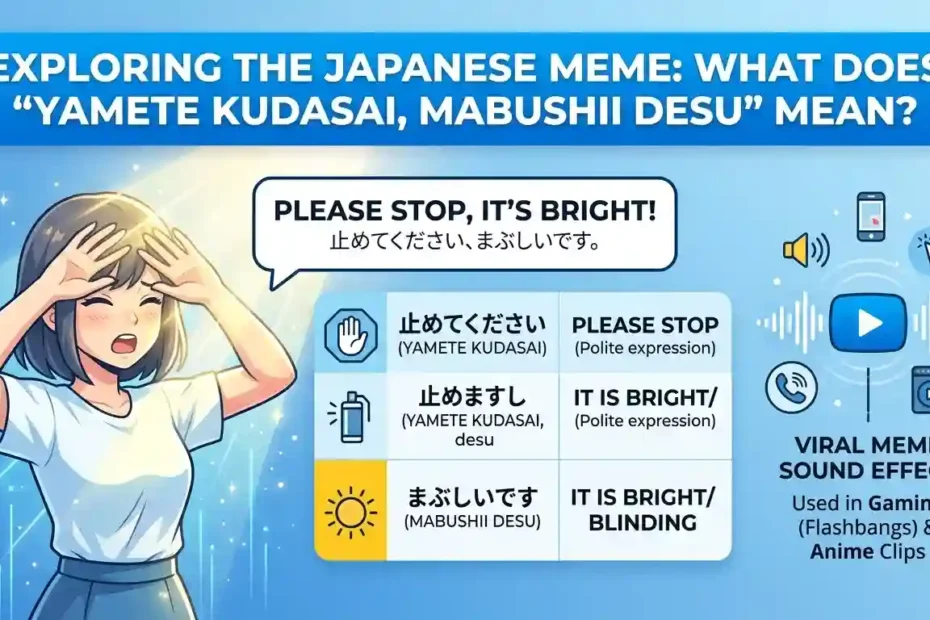
Hearing a dramatic Japanese audio clip across social media without context creates instant confusion. You stumble upon the viral phrase in short videos, memes, or soundboards, but automatic translators often fail to capture the true internet culture meaning. This comprehensive guide breaks down the exact translation, cultural origin, and meme history behind yamete kudasai, mabushii desu so you fully grasp the viral trend.
What Is the Direct Translation of Yamete Kudasai, Mabushii Desu?
The full phrase yamete kudasai, mabushii desu translates to “Please stop, it is bright!” or “Please stop, it is blinding!” in English. The phrase combines two distinct expressions into one dramatic reaction.
In Japanese, the phrase is written as やめてください、まぶしいです. Internet users often share the line as a exaggerated reaction to bright lights, flashbangs in video games, or overwhelming visual effects.
Breakdown of the Japanese Grammar and Words
To understand yamete kudasai, mabushii desu, you can split the phrase into individual Japanese grammatical components.
- Yamete (やめて): The conjunctive te-form of the verb yameru (止める), which means “to stop” or “to cease.”
- Kudasai (ください): A polite auxiliary verb meaning “please,” derived from kudasaru.
- Mabushii (まぶしい / 眩しい): An i-adjective that translates to “bright,” “dazzling,” or “glaring.”
- Desu (です): The polite copula verb equivalent to “is,” “am,” or “are.”
Combining these elements creates a polite yet urgent plea to stop a blinding light source.
What Does Yamete Kudasai Mean on Its Own?
Understanding yamete kudasai meaning requires examining how Japanese speakers use request forms in daily conversation. On its own, yamete kudasai means “please stop.”
Japanese language resources like Tofugu note that adding kudasai adds a layer of formal politeness. Without kudasai, simply saying yamete acts as a direct command: “Stop it!”
In anime and manga, voice actors deliver the line with varying levels of distress, annoyance, or playful exaggeration, giving it a memorable quality.
Why “Mabushii Desu” Adds the Core Humor to the Meme
The addition of mabushii desu transforms a standard request into a comical internet meme. While yamete kudasai appears frequently in dramatic media, pairing it with “it is bright” creates an amusing contrast.
Content creators use yamete kudasai, mabushii desu in gaming montages when flash grenades blind players. The high-pitched voice acting turns a stressful moment in gameplay into humor.
The Viral Origin of the Yamete Kudasai, Mabushii Desu Sound Clip
The original voice sample gained momentum through online video sharing sites and Japanese voice acting audio tracks. Over time, content creators isolated the vocal performance to create a portable sound clip.
Language learning platforms such as Jisho document the literal definitions, but internet culture gave the audio sample its status as a widespread sound effect. Social media users attached the audio to clips of pets staring into sunbeams, sudden phone screen brightness at night, and intense video game lighting.
How the Yamete Kudasai Meme Spread Across TikTok and Soundboards
Short-form video platforms turned the audio track into a global trend. Users searching for a yamete kudasai sound effect found thousands of short videos utilizing the voice sample.
- TikTok and Reels: Creators overlay the audio on clips showing unexpected brightness.
- Soundboards: Gamers stream the audio through Discord and live chat platforms.
- GIF Animations: Video editors pair the audio with blinking anime characters to create a yamete kudasai gif.
The accessibility of soundboard apps allowed millions of users to download and share the clip instantly.
Common Misconceptions About Yamete Kudasai in Anime Culture
Many western fans wonder what is yamete kudasai used for outside of memes. Because the phrase appears across mature media, anime, and gaming, casual listeners sometimes misunderstand its polite context.
- Misconception 1: The phrase is inherently inappropriate. Reality: It is standard, polite Japanese used in daily life.
- Misconception 2: It only exists in internet memes. Reality: It appears regularly in everyday conversations, books, and television shows.
- Misconception 3: Yamete and yamero mean different actions. Reality: Both mean “stop,” but yamero is a harsh masculine command.
Key Differences Between Yamete, Yamete Kudasai, and Dame
Japanese offers several ways to tell someone to stop or express prohibition. The table below compares common stop phrases found in anime and daily speech.
| Japanese Phrase | Romaji | English Translation | Tone & Formality Level |
| やめてください | Yamete kudasai | Please stop | Polite / Standard Request |
| やめて | Yamete | Stop it | Casual / Direct |
| やめろ | Yamero | Stop! (Command) | Rough / Imperative |
| だめです | Dame desu | That is not allowed | Polite Prohibition |
| やめてください、まぶしいです | yamete kudasai, mabushii desu | Please stop, it is bright! | Dramatic / Meme Phrase |
Comprehensive Breakdown of Yamete Kudasai Variations
Different contexts alter how native speakers express “stop” in Japanese. Linguistic studies on NHKI World-Japan highlight how subtle suffix changes shift tone.
- Yamete kure: Casual request used mostly by male speakers.
- Yame nasai: Directive often used by parents or teachers toward children.
- Yame itadakemasu ka: Extremely polite business-level request to cease an activity.
Knowing these variations helps learners recognize nuances in media beyond the yamete kudasai anime tropes.
Where to Download and Use the Yamete Kudasai Sound Effect
Streamers and content creators frequently search for a yamete kudasai sound download to use in video editing software. Sound button websites host public domain and user-submitted clips of the audio track.
When using sound clips in public streams, creators ensure the audio level matches their broadcast balance. Combining the audio with sudden flash effects creates an immediate punchline for audiences.
Psychological Impact of Voice Acting in Japanese Internet Tropes
The success of yamete kudasai, mabushii desu relies heavily on high-pitched voice acting style (anime koe). High tonal pitch creates clear contrast when paired with everyday actions like opening a refrigerator in the dark.
This contrast fuels viral sharing. Listeners instantly recognize the dramatic inflection, making the phrase an enduring element of digital anime culture.
Frequently Asked Questions
What does yamete kudasai mean?
Yamete kudasai means “please stop” in Japanese. It combines the verb yameru (to stop) with the polite request word kudasai (please).
What is yamete kudasai, mabushii desu in English?
Yamete kudasai, mabushii desu translates directly to “Please stop, it is bright!” or “Please stop, it is blinding!” in English.
Where does the yamete kudasai sound clip come from?
The sound clip originated from Japanese audio media and anime voice lines before viral clips spread across TikTok, YouTube, and soundboard websites.
Is yamete kudasai polite or informal Japanese?
It is polite standard Japanese. The addition of kudasai makes it respectful compared to the casual command yamete.
Why is yamete kudasai, mabushii desu so popular in memes?
The contrast between dramatic voice acting and the trivial complaint of bright lighting makes the audio sample perfect for gaming and video reaction clips.
How do you write yamete kudasai in Japanese characters?
You write it in Hiragana as やめてください. When full context includes brightness, it is written as やめてください、まぶしいです.
Understanding yamete kudasai, mabushii desu gives you a clear window into Japanese internet humor and daily language structure. test out your knowledge by sharing this guide with fellow anime fans or using the phrase correctly in your next video creation project!