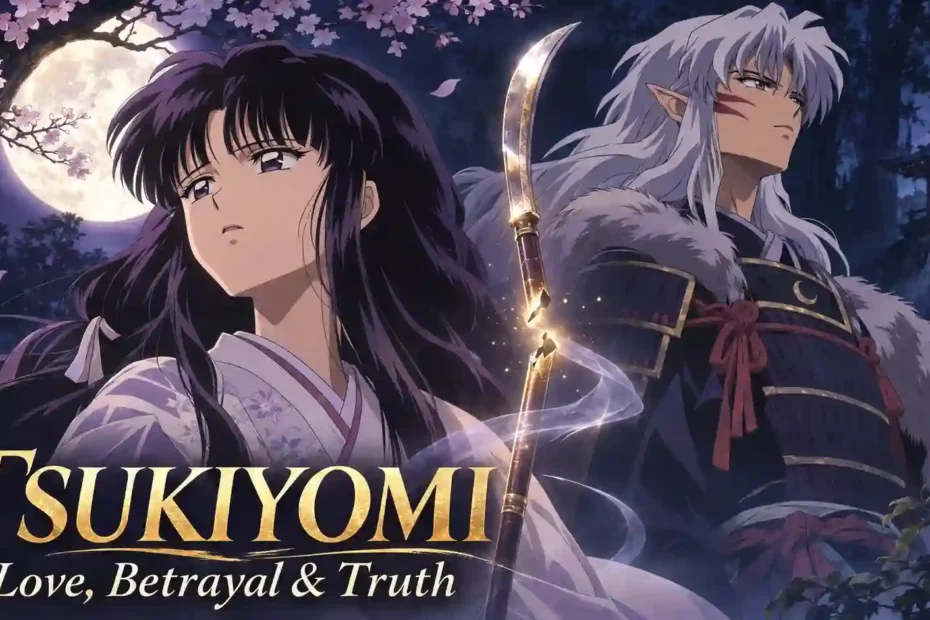
Searching for Inuyasha Tsuki can leave you with a name but no clear story. Confusing character labels and missing episode context make Tsukiyomi’s connection to Hoshiyomi harder to follow than it should be. This guide explains who she is, why she sealed the dangerous Naginata of Kenkon, and how her return through Kagome changes the meaning of a heartbreaking betrayal.
Spoiler warning: This article discusses the storyline and ending of the original Inuyasha anime’s episodes 137–140.
Who Is Inuyasha Tsuki?
Inuyasha Tsuki refers here to Tsukiyomi, the human woman connected to Hoshiyomi in the Naginata of Kenkon storyline. The official Japanese episode summaries identify her as Tsukiyomi, written 月黄泉, rather than as a separate character named Tsuki.
She matters because Hoshiyomi’s understanding of her actions drives his anger. He believes that she betrayed him, took his weapon, and sealed him away.
The later explanation changes that picture. Tsukiyomi feared the Naginata of Kenkon, separated its blades, and sealed them, but the effort exhausted her and she died.
Her story therefore depends on an important distinction: what Hoshiyomi believes happened is not the same as the complete explanation the arc eventually provides. Keeping those two things separate makes the entire storyline easier to understand.
Tsukiyomi is not a new member of Inuyasha’s traveling group. She belongs to an earlier tragedy that reaches into Kagome and Inuyasha’s present adventure.
What Should You Know About Tsukiyomi at a Glance?
Before following the full story, it helps to separate the main people, objects, and events. The table below gives you a practical reference without mixing character facts with interpretation.
| Topic | Clear explanation | Why it matters |
|---|---|---|
| Character name | Tsukiyomi | This is the name to use when checking episode information |
| Japanese name | 月黄泉 | It identifies her in the official Japanese summaries |
| Species | Human | Her bond with Hoshiyomi crosses the human–demon divide |
| Main relationship | Hoshiyomi | Their broken relationship supplies the arc’s emotional conflict |
| Associated weapon | Naginata of Kenkon | The weapon links the past tragedy to the present danger |
| Key past action | She separated and sealed the weapon’s blades | Her action stopped the immediate threat but cost her life |
| Hoshiyomi’s belief | She betrayed him | This belief fuels his resentment and revenge |
| Present-day connection | She appears through Kagome | Kagome becomes the means through which the past can speak |
| Storyline to watch | Original anime episodes 137–140 | These episodes provide the setup, confrontation, and resolution |
| Main explanatory episodes | Episodes 139 and 140 | These reveal the accusation and then clarify the truth |
| Ending | The weapon is destroyed, and Hoshiyomi passes on after seeing her | The resolution ends both the physical threat and the personal conflict |
| Best reading approach | Separate plot facts from thematic analysis | This prevents symbolic readings from becoming invented lore |
Use this table as a starting point rather than a substitute for the story. Tsukiyomi’s importance becomes clearer when you understand why Hoshiyomi misreads her actions.
Which Episodes Explain Tsukiyomi’s Story?
For the character intended by Inuyasha Tsuki, watch episodes 137–140 of the original anime in order. The early episodes establish the dangerous weapon and the people carrying the story toward its final confrontation.
Sunrise’s official episode schedule places these four installments together. Its summaries for episodes 139 and 140 explain Hoshiyomi’s accusation, Tsukiyomi’s actions, and the destruction of the weapon.
| Episode | Place in the storyline | What to pay attention to |
|---|---|---|
| 137 | Opening setup | Akitoki Hōjō, the inherited weapon, and the family-history mystery |
| 138 | Escalation | The separated characters and the danger surrounding the weapon |
| 139 | Confrontation and backstory | Hoshiyomi’s account of Tsukiyomi’s supposed betrayal |
| 140 | Truth and resolution | Tsukiyomi’s appearance through Kagome and the weapon’s destruction |
Episode numbers are more useful than season labels when locating this arc. Streaming services and home-video releases can organize long-running anime differently.
If you only want the central explanation, episodes 139 and 140 contain the crucial material. However, starting at episode 137 gives the ending more weight because you understand Akitoki’s role and the threat surrounding the separated blades.
Do not confuse the complete arc’s starting point with Tsukiyomi’s main explanatory scenes. A storyline can begin before it reveals the character whose past gives it meaning.
How Does the Kenkon Storyline Begin?
The arc brings a dangerous inherited object into the group’s path. Akitoki Hōjō carries a blade connected to the Naginata of Kenkon, while Hoshiyomi seeks to reunite the weapon’s parts.
That gives the adventure a clear immediate problem. The heroes must stop a powerful enemy from obtaining what he needs, even before they fully understand his history.
The story also includes a lighter family-history thread involving Kagome’s name. This contrast gives the arc room to move between awkward personal questions, action, and tragedy.
As the danger grows, the weapon stops being merely an object that everyone wants. It becomes evidence of a past conflict and the means through which that conflict threatens new people.
For readers following Inuyasha Tsuki, this setup matters because Tsukiyomi’s story does not unfold in isolation. The anime reveals it through an ongoing rescue and battle, so personal history changes the meaning of events already underway.
A useful first-viewing question is: Who understands the weapon, and who only thinks they do? Different characters act with different amounts of knowledge.
Who Is Hoshiyomi, and Why Does He Matter?
Hoshiyomi is the demon whose bond with Tsukiyomi lies at the center of the tragedy. By the time he confronts Kagome and her companions, anger has shaped his understanding of that relationship.
He believes a human woman he loved turned against him. That belief turns a personal wound into a reason to distrust and threaten others.
His role has two parts:
- As an opponent, he seeks the completed Naginata of Kenkon and endangers the heroes.
- As a tragic character, he acts on an incomplete understanding of Tsukiyomi’s choices.
- As a warning, his story shows how resentment can keep an old injury active.
- As part of the resolution, he must face more than a stronger attack; his false understanding also needs to break.
These points explain why the ending needs both action and revelation. Defeating him physically would stop the immediate danger, but it would not by itself answer the emotional question.
Understanding his pain does not excuse his actions. The arc can make his suffering understandable while still showing that the heroes must stop him.
That balance is central to the story’s appeal. Hoshiyomi is dangerous, but the reason he became trapped in revenge gives the conflict more depth than a simple fight over a weapon.
What Was Tsukiyomi’s Relationship With Hoshiyomi?
Tsukiyomi and Hoshiyomi share a romantic past. Their relationship places a human and a demon on the same emotional ground, despite the divisions that run through the wider series.
The tragedy develops when Hoshiyomi interprets her intervention as rejection. He sees the loss of the weapon and his sealing as proof that she betrayed their bond.
Tsukiyomi’s motive points in a different direction. She feared the weapon’s danger and acted against it, rather than simply abandoning him.
The Inuyasha Tsuki storyline therefore raises a painful question: What happens when a protective act looks like an attack to the person it is meant to help? The answer depends on who gets to explain the past.
Their relationship also gives the weapon emotional importance. Removing it means more than disarming a fighter; it challenges the path Hoshiyomi has chosen.
As literary interpretation, their tragedy suggests that love cannot remain safe when power and resentment control the relationship. That is a reading of the events, not a separately stated rule of the fictional world.
What Is the Naginata of Kenkon?
The Naginata of Kenkon is the demonic polearm that connects Tsukiyomi’s past to Hoshiyomi’s present attack. Its separated parts are known as the Ken blade and the Kon blade.
A naginata is a long-handled weapon with a blade at the end. Understanding that basic shape helps distinguish it from the swords that play other major roles in Inuyasha.
In this arc, the important point is not a detailed weapons classification. It is the danger created when the two parts come together.
Sunrise’s episode 139 summary describes Hoshiyomi using the Kon blade to take Tessaiga’s demonic power. It also explains that power taken from Kagome helps draw the other blade to him.
That makes the weapon dangerous on several levels:
- It threatens the heroes directly in battle.
- It can take power from important opponents.
- Its separated pieces create a race to stop its completion.
- Its influence helps keep Hoshiyomi bound to revenge.
Do not treat the Naginata of Kenkon as another name for Tessaiga. They are different weapons with different roles in the story.
The connection between Inuyasha Tsuki and the weapon is essential: Tsukiyomi’s decisive action concerns its danger, and the final battle must confront the same threat she tried to stop.
Why Did Tsukiyomi Seal the Weapon?
Tsukiyomi sealed the Naginata of Kenkon because she feared its destructive danger. Sunrise’s official episode 140 synopsis explains that she took the weapon from Hoshiyomi, divided its blades, sealed them, and died after exhausting her strength.
This answer corrects the simpler version that Hoshiyomi carries. He remembers betrayal, while the later explanation reveals an attempt to stop something dangerous.
The difference matters because readers can easily mistake a character’s accusation for the story’s final judgment. Episode 139 presents his understanding; episode 140 supplies the missing context.
The sequence is straightforward:
- Tsukiyomi recognizes the weapon’s danger.
- She takes action against it.
- She separates and seals its blades.
- The effort costs her life.
- Hoshiyomi continues to believe that she betrayed him.
Her choice does not produce an easy victory. She prevents an immediate disaster, but she cannot make Hoshiyomi understand what happened.
That unfinished understanding allows the tragedy to continue. When the threat returns, Kagome and her companions face both a dangerous weapon and the consequences of a story left unresolved.
What Powers Does Tsukiyomi Actually Demonstrate?
Tsukiyomi’s role involves supernatural sealing and a later spiritual appearance through Kagome. These are the abilities that matter most to the plot.
Her sealing feat is significant because it acts against the Naginata of Kenkon. However, its cost also matters: she does not perform it without limits or consequences.
A careful account should distinguish demonstrated actions from invented measurements. The official summaries do not supply a numerical power level, an exhaustive technique list, or a reliable ranking against every other spiritual character.
For an accurate Inuyasha Tsuki profile, focus on these supported points:
- She takes the dangerous weapon away from Hoshiyomi.
- She separates and seals its blades.
- She exhausts her strength and dies.
- She later appears through Kagome.
- Her return helps expose the truth behind Hoshiyomi’s anger.
These actions make her important without requiring exaggerated claims. A character can change the outcome of a story without being its strongest fighter.
Comparisons with Kagome or Kikyō should therefore focus on narrative roles and the specific scenes involved. A short appearance does not provide enough evidence for sweeping combat rankings.
How Does Tsukiyomi Appear Through Kagome?
In episode 140, Tsukiyomi appears through Kagome before Hoshiyomi. Her return brings the missing explanation into the present confrontation.
This is not the introduction of a separate adventure in which Tsukiyomi resumes ordinary life. It is a spiritual intervention that addresses the unresolved past.
Kagome’s role matters because she connects the revelation to the ongoing danger. The heroes cannot simply pause the battle, hear a sad story, and assume the weapon will become harmless.
The scene works on two levels:
- Plot: Hoshiyomi encounters the person tied to his supposed betrayal.
- Emotion: The audience receives a different explanation for the act that shaped his hatred.
The Inuyasha Tsuki story becomes easier to follow when this appearance stays separate from claims about reincarnation. A spirit appearing through Kagome does not, by itself, establish that Kagome is that spirit’s reincarnation.
The arc already gives the scene a clear purpose without that extra claim. Tsukiyomi needs a way to reach Hoshiyomi, and Kagome becomes the point of contact.
This distinction prevents a brief supernatural scene from turning into an unsupported theory about Kagome’s identity.
What Happens in the Ending?
The ending combines a physical victory with an emotional release. Neither part fully explains the resolution on its own.
Sunrise’s episode 140 summary states that Akitoki helps create the opportunity for Kagome to recover her spiritual power. Kagome then fires a sacred arrow at the Naginata of Kenkon alongside Inuyasha’s Backlash Wave.
Their combined action destroys the weapon. After its destruction, Hoshiyomi smiles at an apparition of Tsukiyomi and passes on.
For anyone seeking an Inuyasha Tsuki ending explanation, the key point is that the weapon’s destruction ends the immediate threat, while Tsukiyomi’s presence resolves the personal tragedy.
The ending does not restore the couple to a normal shared life. It offers release rather than a reversal of everything they lost.
That distinction explains the bittersweet tone. The truth arrives, but it cannot erase the cost of the earlier events.
The final movement also preserves the heroes’ importance. Tsukiyomi supplies essential emotional context, while Inuyasha, Kagome, and Akitoki contribute to stopping the danger in the present.
How Does Tsukiyomi’s Story Compare With Kikyō’s?
Tsukiyomi’s story invites comparison with Kikyō because both involve love, spiritual power, and an apparent betrayal. Those similarities help viewers connect a short side story with the series’ wider concerns.
The comparison needs clear limits. Similar themes do not make the characters interchangeable, and they do not prove a hidden identity or family connection.
Yomiuri TV’s official series introduction explains that Naraku’s trap turns Inuyasha and Kikyō against each other. Tsukiyomi and Hoshiyomi’s conflict instead centers on the Naginata of Kenkon and Hoshiyomi’s misunderstanding of her intervention.
| Point of comparison | Tsukiyomi and Hoshiyomi | Kikyō and Inuyasha |
|---|---|---|
| Shared emotional concern | Love damaged by apparent betrayal | Love damaged by apparent betrayal |
| Main explanation | A dangerous weapon and misunderstood intervention | Naraku’s deliberate deception |
| Narrative scale | A short storyline | A central relationship across the series |
| Importance of the past | It drives Hoshiyomi’s revenge | It shapes major conflicts and relationships |
| Safe conclusion | Their stories share themes | Their details remain distinct |
The strongest comparison concerns trust. Both storylines show how a false understanding can continue to wound people long after the original event.
For Inuyasha Tsuki readers, this parallel can add meaning without replacing the actual plot. Use it to understand the emotional pattern, not to invent connections the anime does not establish.
What Themes Make This Short Arc Worth Watching?
Tsukiyomi’s limited screen time does not prevent her story from asking difficult questions. The arc brings several major Inuyasha themes into a compact conflict.
Trust needs more than strong feelings
Hoshiyomi’s love does not protect him from misunderstanding. Once he accepts betrayal as the truth, his emotional certainty becomes part of the problem.
The story therefore separates loving someone from understanding their choices. Those two things can fall apart.
Power can distort a person’s priorities
The Naginata of Kenkon offers destructive force while binding Hoshiyomi to danger. His attachment to it helps keep the conflict alive.
As interpretation, the weapon represents power that costs more than it gives. The story makes that idea concrete through battle and personal loss.
A protective choice can carry a terrible cost
Tsukiyomi’s intervention does not leave her safely outside the danger. She pays for the act with her life.
That cost prevents her role from becoming a simple lesson about doing the right thing. The action matters precisely because it demands something irreversible.
Resolution does not always mean restoration
The ending releases the characters from the conflict without giving back their former lives. It allows peace without pretending the tragedy never happened.
This makes the conclusion emotionally different from a straightforward rescue. The heroes can stop further harm, but they cannot recover every loss.
What Are the Most Common Misunderstandings?
Several mistakes can make this storyline harder to understand. Most come from shortening the name, treating accusations as facts, or adding details that the episodes do not support.
Mistake one: Treating “Tsuki” as a verified separate character.
This guide addresses Tsukiyomi. Use her complete name when checking official episode material.
Mistake two: Saying Tsukiyomi simply betrayed Hoshiyomi.
That describes his belief, not the complete explanation. Her concern about the weapon changes the meaning of her actions.
Mistake three: Calling Kagome Tsukiyomi’s confirmed reincarnation.
The spiritual appearance does not establish that claim. Describe what happens without adding an unsupported identity.
Mistake four: Saying love alone destroys the weapon.
The ending includes specific actions by Kagome, Inuyasha, and Akitoki. The emotional revelation matters, but the battle still requires intervention.
Mistake five: Inventing a detailed biography.
The official summaries used here do not provide Tsukiyomi’s exact age, birthday, complete family tree, or exhaustive training history.
Mistake six: Confusing thematic similarity with direct connection.
Tsukiyomi and Kikyō can serve comparable dramatic purposes without being the same person or sharing an established lineage.
A reliable Inuyasha Tsuki guide should leave unknown details unknown. Filling those gaps with confident invention makes a profile less useful, not more complete.
How Should You Watch or Rewatch This Arc?
Watch the four episodes in sequence, then revisit the ending with Hoshiyomi’s earlier claims in mind. The second pass helps separate his assumptions from the explanation the story finally supplies.
You do not need a complicated viewing plan. A few focused questions will make the character relationships clearer.
During the setup
Notice how the weapon moves the characters into danger. Pay attention to Akitoki’s responsibility and to the difference between carrying an object and understanding its full history.
During Hoshiyomi’s account
Ask who is telling the story. His feelings are real, but his interpretation of Tsukiyomi’s motives is incomplete.
During Tsukiyomi’s appearance
Listen for the missing cause behind the sealing. The central question is not whether she acted against the weapon, but why she did so.
During the final battle
Track each character’s contribution. This avoids reducing the ending to either a romantic reunion or a single attack.
Afterward, consider which changed your view more: learning Tsukiyomi’s motive or seeing Hoshiyomi’s final reaction. That question creates a better discussion than a simple ranking of the characters’ strength.
Where Does Tsukiyomi Fit Within the Wider Series?
Inuyasha combines a search for the Shikon Jewel’s shards with stories about loyalty, grief, identity, and dangerous desire. VIZ’s official series overview identifies Rumiko Takahashi as the creator and describes Kagome’s journey into the past alongside Inuyasha.
Tsukiyomi’s arc fits that world because its danger is both supernatural and personal. A weapon threatens lives, but mistaken beliefs give the confrontation its emotional force.
The story also reflects the series’ recurring interest in human–demon relationships. Those relationships can create affection and loyalty, yet fear and mistrust can make them fragile.
This does not mean every short arc carries equal importance to the main plot. Tsukiyomi’s value lies in the focused question her story asks about love and intervention.
The Inuyasha Tsuki topic works best as a character-and-episode guide rather than a general encyclopedia of the whole franchise. Keeping that focus gives readers a complete answer without burying it under unrelated lore.
Related subjects worth exploring next include Kagome’s spiritual abilities, Kikyō’s relationship with Inuyasha, the series’ major weapons, and the role of misunderstandings in its romances.
Which Primary Sources Support This Guide?
Three official organizations provide the source foundation for this article. Their roles differ, so it is important not to treat a general franchise overview as proof of every character detail.
- Sunrise — Official Inuyasha episode schedule and story summaries.
The episode schedule establishes the sequence of episodes 137–140. The summaries for episodes 139 and 140 support the central explanation of Tsukiyomi, Hoshiyomi, the separated blades, Kagome’s role, and the ending. - Yomiuri TV — Official Inuyasha series introduction and production information.
This broadcaster source supports the wider story context, including Kagome, Inuyasha, Kikyō, Naraku, and the central betrayal underlying the series. - VIZ Media — Official Inuyasha series overview.
This publisher and distributor source supports Rumiko Takahashi’s creator credit and the broad premise involving Kagome, Inuyasha, and the Shikon Jewel.
The thematic discussions in this guide are analysis, not quotations from those organizations. No fictional author credentials, interviews, or claims of firsthand production access appear here.
For publication, attach the real writer’s or reviewer’s name and relevant experience only after that person has reviewed the article. A genuine byline and transparent corrections process offer more trust than an unsupported claim of perfect expertise.
Frequently Asked Questions
1. Is Inuyasha Tsuki the same character as Tsukiyomi?
Inuyasha Tsuki refers to Tsukiyomi in this guide, following the intended topic. The official Japanese episode summaries use Tsukiyomi, so that is the clearest name for checking her story.
2. Which episodes should I watch for Tsukiyomi?
Watch original-series episodes 137–140 for the complete storyline. Episodes 139 and 140 provide the central explanation of her relationship with Hoshiyomi and the truth behind the sealing.
3. Why did Tsukiyomi take Hoshiyomi’s weapon?
She feared the Naginata of Kenkon’s danger. She took it, separated and sealed its blades, and died after exhausting her strength.
4. Is Kagome a reincarnation of Tsukiyomi?
The events discussed here do not establish that. Tsukiyomi appears through Kagome, but a spiritual appearance does not by itself prove reincarnation.
5. What happens to Hoshiyomi at the end?
Kagome and Inuyasha destroy the Naginata of Kenkon after Akitoki helps create an opening. Hoshiyomi then smiles at an apparition of Tsukiyomi and passes on.
6. Is Tsukiyomi’s story worth watching?
Yes, if you enjoy the series’ tragic romances and conflicts built around trust. The four-episode storyline combines a dangerous weapon, a misunderstood sacrifice, and a bittersweet resolution.
Watch the Ending With the Full Story in Mind
Tsukiyomi’s story becomes most affecting when you stop treating it as a simple betrayal. Her attempt to contain a dangerous weapon leaves behind a misunderstanding that threatens people long after her death.
The ending answers both sides of that conflict. Kagome and Inuyasha help destroy the immediate danger, while Tsukiyomi’s appearance allows the personal truth to reach Hoshiyomi.
Start with episode 137, watch through episode 140, and pay attention to how each new detail changes your judgment. Then share your reading: Was Hoshiyomi’s deepest mistake trusting the weapon, or refusing to question what he believed about Tsukiyomi?