Teach Me First Manga
You would like a person to Teach Me First Manga. Not a list of fifty titles. Not a history lesson. A no-nonsense approach: Where do you begin?
Let me be clear right now. Manga is not complicated. But the manner in which nearly everybody talks about it, newcomers get confused even before they crack open a book. Industry jargon like shonen and isekai are tossed around like everyone was born knowing them. You weren’t. That’s fine.
Here is what you very much do need: one decent starting manga, and a sense of how to approach reading, and permission to disregard the rest until you are prepared for it. That’s this entire guide.
What Actually Is Manga? (And Why Comics Is Not The Same Thing)
Manga: The Japanese term for comics However, outside of Japan, it refers to a particular type of Japanese comic with its own conventions. A few things will surprise you if you have never used one previously.
The Right-to-Left Reading Rule
Open any manga. The “front” cover is the equivalent of the back cover on a Western book. You have to flip it open from what seems like the far end of the book. Then, you flip through the pages from the back to the front. The panels go right to left. The text balloons hit from right to left
The first three pages are a little bizarre. Then your brain adjusts. After the tenth page you won’t care anymore.
Black & White vs Full Color
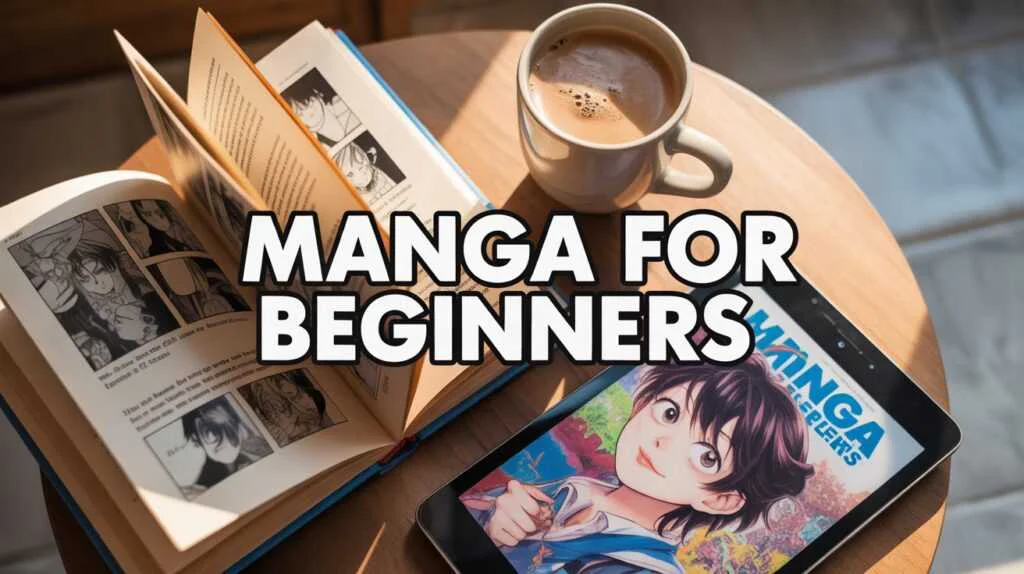
Independent manga is almost all monochrome. This isn’t a budget choice. It is an intentional, artistic tradition which enables artists to continue creating high quality chapters week after week. The absence of color lends itself to a focus on line work, shading, and composition. Give it a chance. Black and white ink defines some of the most beautiful art you will witness.
Compelled by Serial Narratives vs a One-Line Graphic Novel
In the West, comics tend to put out one-shot graphic novels. Manga usually serializes into weekly or monthly chapters collected into volumes known as “tankobon.” While a manga volume is one volume of probably 180-200 pages. Most series get 10-50 volumes before they die, although a few monsters exceed 100.
The good news is you do not have to commit to an entire series. Read the first volume. If you like it, keep going. If not, you wasted an afternoon, not a month.
Before You Start: 3 Things Every First-Timer Needs to Know
Don’t Try to “Catch Up” on a Long Series
The worst advice beginners get is to start a 1000-chapter series like One Piece or Naruto. Those are wonderful stories. They are terrible first manga. You will look at the volume count, feel exhausted, and never start.
Start short. Start complete. Start something that respects your time.
Reading Digitally Is Perfectly Fine (No Gatekeeping)
Some purists say you must hold physical paper. Ignore them. Reading on a phone, tablet, or laptop removes the “where do I even buy this” barrier. Digital apps let you read the first few chapters of almost any series for free. That’s how most new readers start now.
You Don’t Need to Understand Japanese Culture First
Manga set in Japan will show you Japanese schools, foods, and customs as you read. You don’t need a primer. The story explains what matters through context. A character eats rice balls? You’ll figure it out. They take off shoes at the door? The art shows you. Trust the medium.
The Five Best “First Manga” for Absolute Beginners
These five titles work for different tastes. Pick the one that sounds most like the TV shows and movies you already love.
Death Note – For Thriller and Strategy Lovers
A genius high school student finds a notebook that kills anyone whose name he writes in it. He decides to rid the world of criminals. The world’s greatest detective tries to stop him.
Why it works as a first manga:
The premise hooks you in one sentence. The art is clean and readable. The story moves fast. It’s complete in 12 volumes (shorter than most). And because the main character is a villain, you stay engaged trying to decide whose side you’re on.
What kind of person loves this:
Fans of Breaking Bad, House of Cards, or any show where you root for someone you probably shouldn’t.
Fullmetal Alchemist – The Complete Package
Two brothers use alchemy to try bringing their dead mother back. It goes wrong. One loses his entire body. The other loses an arm and a leg. Now they hunt for the Philosopher’s Stone to fix themselves.
Why it works as a first manga:
This is the most universally praised manga among fans for good reason. Great action. Genuinely funny humor. A plot that ties up every single thread by the end. No filler chapters. Complete in 27 volumes. If you read only one manga in your life, pick this one.
What kind of person loves this:
People who enjoy Avatar: The Last Airbender or Star Wars. Adventure yarns with genuine weight and soul.
My Love Story!! – For Rom-Com Fans
Takezo is a seemingly menacing high schooler with a heart of gold. He seems to be mainly about scoring with the ladies, but every time he goes after a girl, she always chooses his best friend, who is a pretty boy. Until a girl, Yamato, ends up liking Takezo himself.
Why it works as a debut manga:
You aren’t teased for 50 chapters before the romance starts, it is clearly established early on in the novel. The male lead is awfully sweet, and not the brightest crayon in the box, in the most adorable way imaginable. The female lead has personality. And the bond between Takezo and his best friend is completely effects-you-in-the-heart material. Complete in 13 volumes.
Who would be a person that loves this:
Anyone who appreciates Kim Possible, Scott Pilgrim, or any romcom where the nice guy ends up winning!
A Silent Voice Collected in One Palette
Years after he mercilessly bullied a deaf girl in elementary school, a boy runs into her. He’s learned sign language. He wants to apologize. And she has her own demons to wrestle with.
Why it works as a first manga:
May also be a single volume (and / or seven smaller volumes as the editions are) If it takes me less than two hours, you can do it in two hours. It touches on guilt, forgiveness, and disability with a beautifully fragile touch. No fights. No magic. And that is just human beings being human beings — messy and trying to do better.
You know who loves this sort of thing:
Those who cried while watching Eternal Sunshine of the Spotless Mind or Your Name. Prepare to feel things.
Dragon Ball – The Oldie That Still Delivers
A super strong kid with a monkey tail encounters a genius girl on the hunt for mystical orbs that can summon a wish granting Dragon. They become friends. They fight increasingly absurd opponents.
Why it’s great as a first manga:
It’s the formula for practically every action manga that followed. However, unlike its contemporaries, the original Dragon Ball is a breakneck experience. The early volumes are straight-up adventure comedy before it turns into a fighting series. The artwork is Akira Toriyama at his whimsicle best. Do not start with Dragon Ball Z, start from vol. 1
What kind of person loves this:
Anyone who enjoyed the original Teen Titans, Adventure Time, or kung fu movies from the 1970s.
How to Read Manga (The Physical Mechanics)
Let me walk you through opening your first volume.
Starting from the “Back” of the Book
Pick up any manga. Flip it over. The cover you’re now looking at? That’s actually the front. Open it from this side. Yes, it feels wrong. Do it anyway.
The spine will have the title printed so it reads from bottom to top. That’s how you know you’ve got the right orientation.
Following Panels Left-to-Right? Actually No
Look at a page of manga. Find the top right corner. That’s where you start. Move your eyes to the panel directly below it. Then go to the next column of panels moving left. When you reach the bottom left corner, flip the page.
Think of it as a reverse Z pattern instead of a Z pattern.
What Those Little Numbers in the Margins Mean
In many manga volumes, you’ll see small numbers in the outside margins. Those are page numbers. But because Japanese reads right-to-left, page 1 is where page 200 would be in a Western book. Don’t overthink it. Just follow the numbers in order from where you start.
Where to Get Your First Manga Right Now
You can read a legitimate first manga within ten minutes of finishing this article. Here’s how.
Free and Legal Apps
Manga Plus (owned by Shueisha, Japan’s largest publisher) lets you read the first three chapters of almost every series they publish for free. You can also read the latest three chapters of ongoing series. No credit card required.
Shonen Jump app costs $2.99 per month in most countries. That gives you access to over 15,000 chapters. Read the first month, cancel if you want, keep the books you liked.
Both apps handle the right-to-left formatting automatically. Just tap to advance.
Library Options Worldwide
Most public libraries carry manga now. If yours doesn’t, ask about interlibrary loan. Libby and Hoopla (library apps) offer digital manga borrowing in dozens of countries. Your library card is free. The books are free. This is the best deal in reading.
Buying Physical Copies Without Breaking the Bank
Used manga sells for $5-8 per volume on sites like eBay, AbeBooks, and Better World Books. Local comic shops often have bargain bins. The Right Stuf and Book Depository (RIP) had good prices; now check Crunchyroll’s store or Amazon’s “Good Condition” used listings.
Don’t buy box sets until you know you like a series. Start with volume one used. Upgrade later.
Which Manga “Demographic” Is Right for You?
These labels describe target audiences, not restrictions. Read whatever you want.
Shonen (Young Boys – But Everyone Reads It)
Action, friendship, training arcs, big fights. Think Dragon Ball, Naruto, My Hero Academia. The most popular manga worldwide falls here. Fast-paced, high energy, usually funny.
Good first shonen: Fullmetal Alchemist or Dragon Ball
Shojo (Romance and Emotional Stories)
Focus on relationships, internal feelings, and personal growth. Art tends to be more flowery with bigger eyes. Think Fruits Basket, Ouran High School Host Club, Kimi ni Todoke.
Good first shojo: My Love Story!! or A Silent Voice
Seinen (Adult Themes, Complex Plots)
Written for adult men. More violence, more moral ambiguity, slower pacing. Think Berserk, Vinland Saga, 20th Century Boys. Not necessarily explicit, but assumes mature life experience.
Good first seinen: Death Note (often debated between shonen and seinen)
Josei (Realistic Life for Women)
Realistic stories about adult women navigating work, relationships, and identity. Less fantasy, more grounded drama. Think Nana, Paradise Kiss, Wotakoi.
Good first josei: Wotakoi (romantic comedy about office workers who are also otaku)
Don’t stress these categories. They’re marketing tools. Pick a story that sounds interesting and ignore the label.
Three Mistakes That Ruin First Manga Experiences
Starting Episode 1 of a 1000-Chapter Series
One Piece is wonderful. It’s also 100+ volumes and still running. As a first manga, it’s a trap. You’ll feel like you’re climbing a mountain that never ends. Save epics for your tenth manga, not your first.
Reading Something “Important” Instead of Something Fun
Some beginner guides will recommend “culturally significant” manga from the 1970s with rough art and slow pacing. Those are homework. You don’t need homework. You need a book you want to keep turning pages of. Read what looks fun, not what looks important.
Forcing Yourself to Finish What You Hate
Put down any manga that doesn’t grab you by the end of volume one. Life is too short. The community will tell you “it gets good after 50 chapters.” That’s stockholm syndrome, not a recommendation. Drop it. Try something else.
What to Read After Your First Manga
Finished your first volume? Want more? Here’s your path forward.
Short Series First (Under 20 Volumes)
- Parasyte (8 volumes) – Body horror with surprising heart
- Pluto (8 volumes) – A detective story about murdered robots
- All You Need Is Kill (2 volumes) – Groundhog Day with alien invasions
Try a Different Demographic
Liked the action of shonen? Try seinen for darker stakes. Liked the romance of shojo? Try josei for older characters. Each demographic offers a completely different flavor of storytelling.
Explore by Genre, Not Just Popularity
“MyAnimeList” and “Anime-Planet” let you search manga by genre tags. Want a cooking manga with tournament arcs? That exists (Food Wars). Want a quiet manga about camping? That exists (Laid-Back Camp). Want a manga about playing badminton in space? Probably exists.
You now have everything you need. Pick one title from the five above. Find it on Manga Plus or your library app. Read the first chapter. If you smile or lean forward or feel anything, keep reading.
That’s how everyone starts. One book. One page. One panel at a time, right to left, until the story takes over and you forget you ever thought this was complicated.
Go read your first manga.
FAQs
Q1: Isn’t it difficult to read manga for the first time?
No. It takes about three pages for the right-to-left format to feel right. After that, it’s just reading. Beginners typically adapt faster than they anticipate.
Q2: Will I be able to read Manga on my cellphone?
Yes. Fumble through apps like Manga Plus and Shonen Jump to read on-deck for phones. Zoom by pinching, advance by tapping, no setup.
Q3: What is the one best first manga for an action non-fan?
A Silent Voice. A single volume, none of the fights but a touching story about bullying and forgiveness. Works for almost anyone.
Q4: Was your Series Do I have to start at volume one?
Always. Manga tells one continuous story. If you start in the middle it will be confusing. There was a volume one for a reason.
Q5: How long does it take to read 1 volume of manga?
It takes the average reader 1-2 hours to complete a 180-page book. Faster readers in 45 minutes. Slower readers in 3 hours. There’s no wrong speed.
About the Author