INTRODUCTION
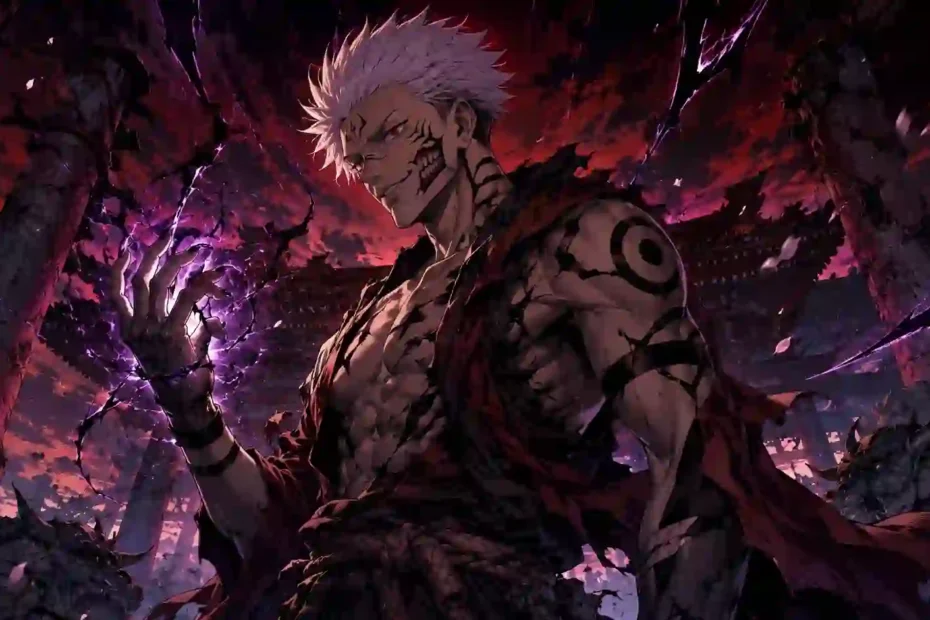
Fifteen hundred years of pure malice, packed into two grinning mouths. That’s Sukuna in one sentence. No villain in modern shonen manga has generated this much fear, fascination, and outright dread since his fingers started scattering across Japan. Sukuna isn’t just a strong antagonist. He’s a walking argument that some monsters were never meant to be defeated, only endured.
If you’ve landed here, you already know the name. What you might not know are the details buried inside his fights, his philosophy, and the brutal turns his story takes. This breakdown covers his origin as a cursed womb-death specimen, his terrifying Domain Expansion, the fallout of his war with Gojo, and his unsettling occupation of Megumi’s body. No filler. Just the King of Curses, dissected panel by panel.
BODY SECTIONS
Who Is Ryomen Sukuna? The Origin of the King of Curses
Ryomen Sukuna wasn’t born a curse. He was born human, over a thousand years ago, and that’s the detail that makes him disturbing.
- He lived during the Heian era as a sorcerer so powerful humanity feared him more than any curse.
- After death, his remains splintered into twenty fingers, each one a cursed object of near-unlimited power.
- Swallowing even one finger grants immense cursed energy — and immense risk.
His backstory isn’t tragic redemption material. It’s a warning. Power like his doesn’t corrupt people. It reveals what they already were.
The Two-Faced Symbol
Sukuna’s design references a real historical demon myth from Japanese folklore, tied to the Hida region. That grounding gives him a weight most fictional villains lack. He doesn’t feel invented. He feels excavated.
Ryomen Sukuna’s Power Set: Why He’s Untouchable
Every arc reinforces the same idea: Sukuna is playing a different game than everyone else on the board.
His core techniques include:
- Dismantle — an invisible slashing technique that cuts through nearly anything.
- Cleave — a wide-range extension of Dismantle, devastating in open combat.
- Fire Arrow — a cursed-energy blast capable of leveling city blocks.
- Malevolent Shrine — his signature Domain Expansion.
Sukuna Domain Expansion: Malevolent Shrine Explained
The sukuna domain expansion sequence remains one of the most talked-about moments in the entire series. Malevolent Shrine slices everything inside its radius, expanding outward with near-absolute lethality.
What makes it terrifying isn’t just the damage. It’s the certainty. Most Domain Expansions guarantee a technique will land. Sukuna’s guarantees destruction on a citywide scale.
Featured Snippet Answer — What is Sukuna’s Domain Expansion called?
Sukuna’s Domain Expansion is called Malevolent Shrine. It automatically slices apart anything within its range using his Dismantle and Cleave techniques, and its area of effect is large enough to devastate entire city blocks in a single activation.
Gojo vs Sukuna: The Fight That Redefined the Series
The gojo vs sukuna clash isn’t just a fight. It’s the thesis statement of the entire manga.
Two men, both considered untouchable in their respective eras, finally colliding wasn’t hype for hype’s sake. It forced fans to ask an uncomfortable question: what happens when the “strongest” isn’t strong enough?
Why This Battle Hit Differently
- It broke the assumption that Gojo was narratively invincible.
- It reframed Sukuna as a threat operating outside conventional power scaling.
- It permanently altered the power balance of the entire jujutsu world.
Whatever your opinion on the outcome, this fight will be referenced in shonen discussions for years. It’s that consequential.
Sukuna and Megumi: A Body Under Siege
The sukuna megumi arc is where the manga gets genuinely disturbing. Sukuna doesn’t just possess a vessel. He occupies Megumi’s body while Megumi remains conscious, trapped, aware of everything happening.
That detail changes the horror completely. This isn’t demonic possession as spectacle. It’s psychological captivity.
The Emotional Weight Fans Overlook
- Megumi’s autonomy becomes a central thematic battleground, not just a plot device.
- Other characters’ desperation to save him adds emotional stakes beyond raw combat.
- The arc forces the story to confront what “victory” actually costs.
This is where Sukuna stops being an antagonist you admire from a distance. He becomes something you actively want gone.
The Sukuna Manga: Reading Experience and Art Direction
The sukuna manga panels dedicated to him consistently rank among the series’ best artwork. Sharp linework, brutal negative space, and deliberate panel pacing all sell his menace without needing constant dialogue.
Gege Akutami doesn’t oversell Sukuna with words. The art does the talking:
- Wide panels during Domain Expansion sequences emphasize scale.
- Close-up eye shots during dialogue heighten psychological tension.
- Minimal cursed-energy visual clutter keeps focus on his expressions.
That restraint is why he lands as genuinely frightening rather than cartoonishly evil.
Mature Themes: Should You Read This Series?
This isn’t a beginner-friendly comic. Expect graphic violence, body horror, and heavy psychological themes throughout Sukuna’s arcs.
If you’re comfortable with intense shonen content, this delivers some of the genre’s most memorable villain writing. If graphic dismemberment and existential dread aren’t your thing, approach with caution.
CONCLUSION & CALL TO ACTION
Sukuna works because he refuses to be simple. He’s not evil for shock value, and he’s not sympathetic for redemption bait. He’s just honest about what unchecked power actually looks like, and that honesty is what makes him unforgettable.
Whether you’re here for the Domain Expansion spectacle, the Gojo rivalry, or the horror of the Megumi arc, Sukuna delivers one of manga’s most complete antagonist studies in recent memory. Few villains earn this much analysis. He earns every bit of it.
So, who actually wins the long-term power debate — Sukuna or Gojo? Drop your take in the comments below, and bookmark this site for more deep-dive breakdowns on manga’s most complex characters.