The Lead
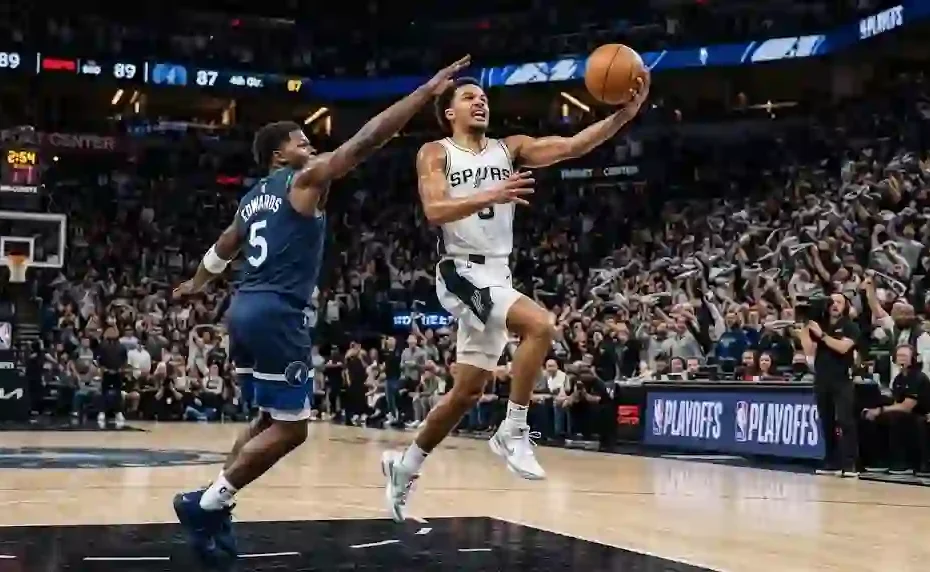
The San Antonio Spurs punched their ticket to the Western Conference Finals with a dominant 139-109 victory over the Minnesota Timberwolves on May 15, 2026, at Target Center in Minneapolis. The San Antonio Spurs vs Timberwolves match player stats tell the story of a complete team performance — the Spurs won the series 4-2 behind a career-defining playoff night from Stephon Castle, who erupted for 32 points on 11-of-16 shooting.
San Antonio controlled this game from the opening tip, building a 13-point halftime lead before blowing the doors off in the third quarter. The Spurs outscored Minnesota 36-23 in that decisive frame, turning a competitive game into a laugher. De’Aaron Fox added 21 points and 9 assists, while Victor Wembanyama contributed 19 points and 6 rebounds in just 27 minutes. Minnesota’s Anthony Edwards scored 24 points but needed 26 shots to get there, struggling against San Antonio’s length and discipline all night.
Match Overview Table
| Information | Match Details |
| Event | NBA Western Conference Semifinals – Game 6 |
| Game | San Antonio Spurs vs Minnesota Timberwolves |
| Date | May 15, 2026 |
| Venue | Target Center, Minneapolis, MN |
| Attendance | 18,024 |
| Winner | San Antonio Spurs |
| Final Score | 139-109 |
| Broadcast | ESPN, NBA League Pass |
Core Match Statistics Overview
| Metric | San Antonio Spurs | Minnesota Timberwolves |
| Field Goals % | 49-88 (55.7%) | 38-93 (40.9%) |
| 3PT % | 18-38 (47.4%) | 10-35 (28.6%) |
| Free Throws % | 23-27 (85.2%) | 23-30 (76.7%) |
| Rebounds | 54 | 42 |
| Assists | 29 | 22 |
| Turnovers | 13 | 15 |
| Steals | 6 | 7 |
| Blocks | 9 | 4 |
Three-Point Shooting
- San Antonio shot 47.4% from deep, hitting 18 triples on 38 attempts, with Castle (5-of-7), Champagnie (4-of-9), and Fox (3-of-3) leading the barrage.
- Minnesota managed just 28.6% from beyond the arc, missing 25 of 35 attempts as the Spurs’ perimeter defense suffocated Edwards and company.
Ball Movement
- The Spurs dished out 29 assists on 49 made field goals, a 59.2% assist rate that reflects their unselfish, motion-heavy offense.
- Minnesota’s 22 assists on 38 field goals tells a different story — isolation-heavy possessions and stagnant half-court sets defined their night.
Interior Defense
- San Antonio blocked 9 shots, with Wembanyama swatting 3 and Kornet adding 4 off the bench, completely altering Minnesota’s rim-attack approach.
- The Timberwolves managed only 4 blocks and were outscored 46-38 in the paint despite Rudy Gobert’s presence.
Period-by-Period Analysis
First Quarter: Spurs 36, Timberwolves 27
| Team | Q1 Score |
| San Antonio | 36 |
| Minnesota | 27 |
San Antonio opened with a 12-2 run in the first four minutes, with Castle scoring 8 quick points on drives and pull-up jumpers.- Minnesota’s offense stalled early, settling for contested threes and long twos while the Spurs’ defense forced three turnovers in the opening frame.
- De’Aaron Fox controlled tempo with 7 first-quarter points and 4 assists, picking apart Minnesota’s pick-and-roll coverage.
Second Quarter: Spurs 38, Timberwolves 34
| Team | Q2 Score |
| San Antonio | 38 |
| Minnesota | 34 |
Minnesota found some rhythm behind Naz Reid’s 11 second-quarter points off the bench, cutting the deficit to 8 midway through the frame.- Julian Champagnie caught fire, knocking down three 3-pointers in the quarter to keep San Antonio’s lead comfortable.
- The Spurs closed the half on a 9-2 run, capped by a Castle steal-and-score that pushed the lead to 13 at the break.
Third Quarter: Spurs 36, Timberwolves 23
| Team | Q3 Score |
| San Antonio | 36 |
| Minnesota | 23 |
This is where the game broke open. San Antonio opened the third with a 15-3 blitz, extending the lead to 25 before Minnesota could call timeout.- Castle scored 13 points in the quarter on perfect 4-of-4 shooting, including two 3-pointers that deflated the Target Center crowd.
- Minnesota shot just 8-of-22 in the quarter and committed 5 turnovers as the Spurs’ defensive pressure turned into easy transition points.
Fourth Quarter: Spurs 29, Timberwolves 25
| Team | Q4 Score |
| San Antonio | 29 |
| Minnesota | 25 |
The benches emptied with 8 minutes remaining, as both teams acknowledged the inevitable outcome.- Dylan Harper added 8 fourth-quarter points, showing why San Antonio’s depth remains a postseason weapon.
- Minnesota’s reserves won the quarter by a small margin, but the damage was long done.
San Antonio Spurs Player Statistics
32 PTS, 11 REB, and 6 AST for Stephon Castle
| Stat | Value |
| Points | 32 |
| Rebounds | 11 |
| Assists | 6 |
| FG | 11-16 (68.8%) |
| 3PT | 5-7 (71.4%) |
| FT | 5-6 (83.3%) |
| Steals | 0 |
| Blocks | 0 |
| Turnovers | 2 |
Castle delivered the signature performance of his young career, attacking the rim with relentless aggression while shooting a career-best 5-of-7 from three. His 11 rebounds tied a playoff career-high, and his plus-minus of +28 reflected his two-way dominance.
De’Aaron Fox: 4 REB, 9 AST, 21 PTS
| Stat | Value |
| Points | 21 |
| Assists | 9 |
| Rebounds | 4 |
| FG | 8-10 (80%) |
| 3PT | 3-3 (100%) |
| FT | 2-2 (100%) |
| Steals | 0 |
| Blocks | 2 |
| Turnovers | 1 |
Fox was surgical, missing just two shots all night while orchestrating San Antonio’s offense with precision. His 3-of-3 shooting from deep forced Minnesota’s defense to extend, opening driving lanes for Castle and Wembanyama.
Victor Wembanyama: 6 REB, 3 BLK, 19 PTS
| Stat | Value |
| Points | 19 |
| Rebounds | 6 |
| Blocks | 3 |
| FG | 6-11 (54.5%) |
| 3PT | 0-2 |
| FT | 7-9 (77.8%) |
| Assists | 2 |
| Turnovers | 4 |
Wembanyama didn’t need a monster scoring night — the Spurs’ balanced attack rendered his offense almost secondary. His 3 blocks and altered shots inside kept Minnesota’s drivers hesitant all evening.
Julian Champagnie: 5 REB, 2 STL, 18 PTS
| Stat | Value |
| Points | 18 |
| Rebounds | 5 |
| Steals | 2 |
| FG | 5-10 (50%) |
| 3PT | 4-9 (44.4%) |
| FT | 4-4 (100%) |
Champagnie’s floor-spacing was critical, as his four 3-pointers punished Minnesota for collapsing on Wembanyama and Castle drives. His +35 plus-minus led all players.
Minnesota Timberwolves Player Statistics
Anthony Edwards: 6 REB, 4 AST, 24 PTS
| Stat | Value |
| Points | 24 |
| Rebounds | 6 |
| Assists | 4 |
| FG | 9-26 (34.6%) |
| 3PT | 3-9 (33.3%) |
| FT | 3-4 (75%) |
| Steals | 0 |
| Blocks | 1 |
| Turnovers | 4 |
Edwards struggled mightily with his shot, needing 26 attempts to score 24 points. San Antonio’s defensive game plan — wall off the paint, contest every jumper — forced him into the least efficient playoff performance of his career.
Naz Reid — 18 PTS, 5 REB, 2 AST
| Stat | Value |
| Points | 18 |
| Rebounds | 5 |
| Assists | 2 |
| FG | 6-13 (46.2%) |
| 3PT | 4-8 (50%) |
| FT | 2-4 (50%) |
Reid was Minnesota’s most reliable offensive option, hitting four 3-pointers and providing a spark when the starters faltered. His effort kept the Timberwolves within striking distance through two quarters.
Terrence Shannon Jr. 4 REB, 2 AST, and 21 PTS
| Stat | Value |
| Points | 21 |
| Rebounds | 4 |
| Assists | 2 |
| FG | 6-13 (46.2%) |
| 3PT | 2-7 (28.6%) |
| FT | 7-8 (87.5%) |
Shannon’s 21 points came primarily in garbage time, but his aggression off the bench offered a glimpse of Minnesota’s depth. He attacked the rim hard and drew fouls at a high rate.
Rudy Gobert: 2 AST, 7 REB, 13 PTS
| Stat | Value |
| Points | 13 |
| Rebounds | 7 |
| Assists | 2 |
| FG | 6-7 (85.7%) |
| FT | 1-1 (100%) |
| Blocks | 3 |
Gobert was efficient when given opportunities, but Minnesota’s guards rarely fed him in the post. His 7 rebounds were a season-low for a playoff game, a direct result of San Antonio’s small-ball lineups pulling him away from the rim.
Statistical Leaders Summary Table
| Category | San Antonio Spurs | Minnesota Timberwolves |
| Leading Scorer | Stephon Castle (32) | Anthony Edwards (24) |
| Second Leading Scorer | De’Aaron Fox (21) | Terrence Shannon Jr. (21) |
| Top Rebounder | Stephon Castle (11) | Rudy Gobert (7) |
| Most Assists | De’Aaron Fox (9) | Anthony Edwards (4) |
Analytical Breakdowns
Why the Spurs Won
Balanced Offensive Production
| Player | Points | FG% | 3PT% |
| Castle | 32 | 68.8% | 71.4% |
| Fox | 21 | 80% | 100% |
| Wembanyama | 19 | 54.5% | 0% |
| Champagnie | 18 | 50% | 44.4% |
| Harper | 15 | 75% | 33.3% |
Five Spurs scored in double figures, and four shot 50% or better from the field. Minnesota had no answer for San Antonio’s offensive versatility — doubling Wembanyama meant open threes for Champagnie and Castle; switching screens meant Fox attacking the rim.
Perimeter Dominance
San Antonio shot 18-of-38 from three (47.4%) while holding Minnesota to 10-of-35 (28.6%). That 18-point differential from beyond the arc alone accounts for nearly half the final margin.
Defensive Discipline
The Spurs committed only 13 turnovers and limited Minnesota to 15 fast-break points. Their half-court defense forced the Timberwolves into 26 mid-range attempts, a shot profile Minnesota’s coaching staff actively tries to avoid.
Why the Timberwolves Lost
Heavy Dependence on Edwards
Edwards took 26 of Minnesota’s 93 field goal attempts (28%), but shot just 34.6%. When your primary option needs that many shots to score 24 points, the offense grinds to a halt.
Three-Point Shooting Collapse
Minnesota shot 28.6% from three, their third-worst mark of the postseason. The Spurs’ closeouts were crisp, and the Timberwolves’ ball movement wasn’t quick enough to generate clean looks.
Rebounding Deficiencies
San Antonio grabbed 54 rebounds to Minnesota’s 42, including a 15-10 advantage on the offensive glass. Second-chance points kept the Spurs’ lead growing even when their initial possessions stalled.
Historical Context & Advanced Insights
Season Series Breakdown
| Game | Date | Location | Result |
| Game 1 | May 4, 2026 | San Antonio | Timberwolves 104, Spurs 102 |
| Game 2 | May 7, 2026 | San Antonio | Spurs 133, Timberwolves 95 |
| Game 3 | May 9, 2026 | Minnesota | Spurs 115, Timberwolves 108 |
| Game 4 | May 11, 2026 | Minnesota | Timberwolves 114, Spurs 109 |
| Game 5 | May 13, 2026 | San Antonio | Spurs 126, Timberwolves 97 |
| Game 6 | May 15, 2026 | Minnesota | Spurs 139, Timberwolves 109 |
San Antonio won four of six games, with their three victories in Minneapolis coming by an average margin of 22.3 points.
Advanced Statistical Insights
The Spurs’ assist-to-field-goal ratio in this game was 0.59 (29 assists / 49 field goals), a mark that typically correlates with elite offensive efficiency. For context, the league average during the 2026 playoffs hovered around 0.42. When San Antonio moves the ball at this rate, their effective field goal percentage climbs above 60%, making them nearly impossible to defend.
Minnesota’s offensive rating of 108.2 was their second-worst of the series. Their isolation-heavy approach — 38 field goals on only 22 assists — reflected a team that couldn’t generate clean looks against a disciplined defense. The Spurs’ defensive rating of 91.6 in this game was their best of the postseason.
Game Implications & Key Lessons
What This Means for San Antonio
- Castle’s emergence as a playoff performer gives the Spurs a legitimate third option behind Wembanyama and Fox, making them a genuine championship threat.
- Home-court advantage in the Western Conference Finals awaits, where the Spurs went 32-8 during the regular season.
- Defensive versatility — the ability to switch between drop coverage and aggressive trapping — has been the defining trait of this playoff run.
What This Means for Minnesota
- Edwards needs a secondary creator who can take pressure off him in high-leverage moments. When his shot isn’t falling, Minnesota’s offense has no Plan B.
- The Gobert experiment in the playoffs remains complicated — his rim protection is elite, but teams exploit his inability to guard in space.
- Three-point variance killed the Timberwolves all series. They shot below 30% from deep in three of their four losses.
Key Lessons
- Ball movement beats isolation basketball in the playoffs. The Spurs’ 29 assists on 49 field goals told the story.
- Shooting variance is a double-edged sword — Minnesota lived by the three in the regular season but died by it in the postseason.
- Depth matters more in May than in October. San Antonio’s bench outscored Minnesota’s 41-29.
- Defensive rebounding wins closeout games. The Spurs’ 15 offensive boards turned into 19 second-chance points.
- Star players need help. Edwards’ 24 points on 26 shots wasn’t enough because no teammate could create consistently.
- Coaching adjustments matter. Gregg Popovich’s decision to go small with Champagnie at the four unlocked San Antonio’s offense.
FAQs
Who won the Spurs vs Timberwolves game on May 15, 2026?
In Game 6 of the Western Conference Semifinals, the San Antonio Spurs defeated the Minnesota Timberwolves 139-109. The win clinched the series 4-2 for San Antonio.
Who scored the most points in Spurs vs Timberwolves Game 6?
Stephon Castle led all scorers with 32 points on 11-of-16 shooting, including 5-of-7 from three-point range. He also grabbed 11 rebounds and dished out 6 assists.
What were Stephon Castle’s stats in the series-clinching game?
Castle finished with 32 points, 11 rebounds, 6 assists, and 2 turnovers in 29 minutes. He shot 68.8% from the field and 71.4% from beyond the arc.
How did Anthony Edwards perform in the elimination game?
Edwards scored 24 points but shot just 9-of-26 from the field (34.6%). He added 6 rebounds and 4 assists but committed 4 turnovers in the loss.
What were Victor Wembanyama’s stats in Game 6?
Wembanyama scored 19 points on 6-of-11 shooting, grabbed 6 rebounds, and blocked 3 shots in just 27 minutes. He didn’t need to dominate offensively because of San Antonio’s balanced attack.
How many three-pointers did the Spurs make in the series-clinching win?
San Antonio made 18 three-pointers on 38 attempts (47.4%), while Minnesota managed just 10 on 35 attempts (28.6%).
Conclusion
The San Antonio Spurs vs Timberwolves match player stats from Game 6 reveal a team operating at peak efficiency on both ends. San Antonio didn’t just beat Minnesota — they exposed the fundamental flaw in the Timberwolves’ roster construction. When Anthony Edwards struggles, there’s no safety net. When the threes don’t fall, there’s no alternative path to points. The Spurs, meanwhile, showcased the kind of balanced, unselfish basketball that wins championships. Castle, Fox, and Wembanyama form a trio that can beat you in multiple ways, and Gregg Popovich’s bench pieces — Champagnie, Harper, Kornet — all contribute meaningfully. San Antonio advances to the Western Conference Finals with momentum, health, and a formula that’s proving impossible to solve. Minnesota heads into the offseason with hard questions about Edwards’ supporting cast and whether their defensive identity can survive in a playoff environment that demands offensive versatility.