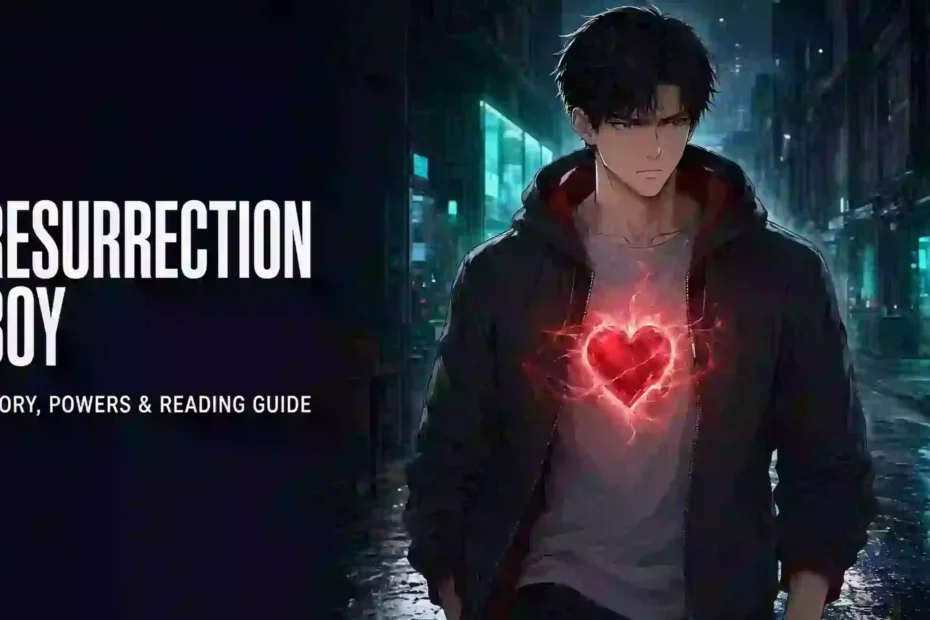
Finding a new action comic should be exciting, not a maze of mixed chapter counts, vague summaries, and accidental spoilers. That confusion makes it hard to know whether Resurrection Boy fits your taste—or where to start safely. This guide explains Ji-o’s story, the heart-based powers, the main early characters, and the official reading options, so you can decide with confidence.
What Is Resurrection Boy About?
Resurrection Boy is a Korean action webtoon by RYU about Ji-o Kim, a boy whose unusual heart allows him to regenerate after severe injuries. After ten years of abuse in a research facility, he escapes—but the people who held him still threaten his freedom.
The central conflict goes beyond winning fights. Ji-o wants food, safety, friendship, and the chance to live as a person rather than someone else’s experiment. His ability keeps him alive, yet it also makes him valuable to people who ignore those needs.
Two useful terms describe the series. Manhwa means Korean comics, while webtoon refers to the digital comic format associated with scrolling episodes. This title fits both descriptions; it is not a Japanese-origin manga.
The Essential Facts at a Glance
The table below separates stable background details from information that can change as new episodes arrive. The episode totals reflect the official listings checked on October 20, 2026, not a permanent chapter count.
| Topic | Verified detail | Why it matters |
|---|---|---|
| Creator | RYU, credited in Korean as 류 | Confirms the correct title and creator when similar names appear in searches. |
| Writing and artwork | The Korean listings credit RYU for both | Avoids inventing a separate novelist, adapter, or artist. |
| Original title | 부활소년 | Helps readers identify the Korean edition. |
| Origin and format | Korean digital comic | Explains the manhwa label and scrolling presentation. |
| Main official genre | Action | Sets expectations for physical conflict rather than a quiet school drama. |
| Lead character | Ji-o Kim | The official English opening uses this name. |
| Central ability | Heart of Resurrection | Connects the title to the story’s heart-based powers. |
| Korean first-episode listing | February 21, 2026 | Identifies the original release year. |
| English first-episode listing | May 23, 2026 | Distinguishes the translation’s launch from the Korean launch. |
| Publication status | Ongoing in the checked Korean records | Readers should not expect a completed story. |
| Advertised English schedule | Sundays | Check the platform for local timing and interruptions. |
| English content rating | Young Adult, 16+ | The youthful lead does not make this a children’s comic. |
| Korean content rating | 15+ | Ratings differ between editions and markets. |
| Official reading services checked | WEBTOON, NAVER WEBTOON, NAVER SERIES | Provides a clear starting point without relying on reposts. |
Who Created the Webtoon?
RYU receives the creator credit on the English series page. NAVER WEBTOON and NAVER SERIES credit 류 for both the writing and artwork, so the official records support identifying RYU as the writer and artist.
Those credits matter when discussing visual storytelling. The opening’s dialogue, character expressions, and unsettling body imagery belong to the same credited creator’s work; there is no need to invent a separate creative team.
The Korean series page also lists 사신소년 among the creator’s other works. That is a useful connection for readers who want to explore RYU’s catalogue, but it does not establish a shared fictional universe or a required reading order.
A shared creator is a verified connection. Claims about personal motives, private experiences, or hidden links between stories need direct evidence from the creator or publisher.
How Does the Story Begin?
Resurrection Boy opens with a desperate escape rather than a comfortable introduction to a powerful hero. Ji-o fears capture, and the early images immediately show that survival has left him in terrible physical condition.
Outside the laboratory, his needs remain painfully ordinary. He searches discarded food, spends time around stray dogs, and struggles with the way strangers react to his appearance. These scenes establish what freedom actually looks like for someone with nowhere safe to go.
He then encounters Hyeji Song, a student who comes to feed the dogs. Their meeting begins awkwardly, but her decision to offer help gives the story a human point of connection. Food, clothing, and simple conversation become meaningful because Ji-o has lived without ordinary care.
The opening also avoids making him purely passive. Even while hungry and frightened, he shares food with a dog and intervenes when people harass Hyeji. Those choices reveal character before the story asks readers to judge his fighting strength.
That contrast provides the clearest way into the plot: a frightening-looking boy acts with care, while people who appear ordinary can behave cruelly. His struggle concerns how others treat him as much as what his body can survive.
Which Early Characters Should You Know?
A useful character guide should explain relationships without exposing later betrayals, deaths, or alliances. These are the names and roles that help a new reader understand the opening.
| Character or group | Opening-story role | What to notice |
|---|---|---|
| Ji-o Kim | Escaped research subject and main character | His kindness, hunger, fear of capture, and desire for a normal life complicate the image of an unstoppable fighter. |
| Hyeji Song | A student who aids Ji-o and feeds stray dogs | Her useful assistance offers him hope that he may be treated differently by others. |
| Tater | A stray dog Ji-o befriends and names | Their bond shows that Ji-o can form attachments even while he lacks security himself. |
| The research facility | Institution responsible for his captivity and experiments | Its treatment of living beings drives the conflict and explains his fear of returning. |
| Other experimental subjects | Part of the wider suffering described in the official premise | Their existence expands the stakes beyond one boy’s escape. |
Ji-o: More Than His Recovery Ability
Ji-o’s visible condition attracts attention before people learn his name. The opening repeatedly places his appearance beside small, considerate actions, asking readers to notice the difference between looking frightening and acting cruelly.
Watch how he handles help, not just attacks. His excitement over a proper meal and his hesitation about placing Hyeji in danger reveal needs that physical recovery cannot meet.
Hyeji: Practical Kindness, Not an Assumed Romance
Hyeji matters because she acts. She brings food, offers assistance, and returns instead of allowing one uncomfortable encounter to define Ji-o forever.
That makes her important without requiring a claim that the story’s central relationship is romantic. A careful introduction describes the bond the opening establishes rather than promising a relationship outcome.
Tater: An Early Emotional Connection
Tater helps show Ji-o’s ability to care for another vulnerable creature. Their scenes give readers a reason to value his gentleness before the violence grows more intense.
Readers sensitive to animal suffering should approach the early episodes carefully. The dogs are not simply a cheerful background detail in an otherwise harmless adventure.
How Does the Heart of Resurrection Work?
The power system in Resurrection Boy centers on unusual hearts. The opening explains that rare mutations give certain people extraordinary abilities, and society calls these individuals Heart Mutants.
Ji-o possesses the Heart of Resurrection, which allows him to recover from damage that would kill an ordinary person. However, regeneration does not mean that injuries never happen or that every wound immediately disappears.
Blood Supports His Regeneration
Early action establishes a practical rule: Ji-o can absorb blood outside his body to help rebuild damaged tissue. During a confrontation, he tries to reach spilled blood because even a small amount can support some recovery.
That detail gives the ability more structure than a simple “he cannot die” description. His physical condition and access to blood matter within the early action, so readers should pay attention to the setting as well as the blows.
Healing Is Different From Invulnerability
An invulnerable character resists damage; a regenerating character repairs damage. Ji-o’s early injuries make that distinction clear, and the laboratory’s abuse shows why surviving harm does not make the harm meaningless.
He also experiences hunger, fear, and isolation. A powerful body does not automatically provide shelter, trust, or protection for everyone around him.
What Should You Avoid Assuming?
The opening does not justify a complete numerical power chart. It also does not support treating every fan theory about his heart as a confirmed weakness or an unlimited new ability.
Keep these distinctions clear:
- Confirmed early: His heart enables extraordinary regeneration.
- Confirmed early: Absorbing external blood supports that recovery.
- Not the same claim: He never feels pain or faces danger.
- Not established by the premise alone: An exact final limit, guaranteed victory, or a complete list of future powers.
Why Does the Laboratory Matter So Much?
The laboratory gives Resurrection Boy its main conflict, not merely its backstory. Ji-o describes forced drug testing and invasive experiments during his captivity, while the official premise connects the facility to the suffering of his friends as well.
The problem is not simply that someone wants to defeat him. The institution treats his ability as something it can control and use, regardless of what he wants.
That difference explains why escape does not settle the story. Leaving a building cannot guarantee lasting safety when the people responsible still want access to the person who escaped.
The facility also creates a larger question about power. If a person’s rare biology makes them useful, who protects their right to refuse? That question gives the action an ethical center without requiring readers to accept the fictional experiments as real science.
When reading later encounters, distinguish an individual attacker’s choices from the wider system that benefits from captivity. A victory in one fight may solve an immediate problem without ending that larger threat.
What Themes Give the Action Meaning?
Resurrection Boy pairs extraordinary survival with ordinary human needs. Its opening works best when readers track both sides rather than measuring every scene by damage and recovery alone.
Survival Is Not the Same as Living Well
Ji-o can remain alive in a condition that leaves him hungry, exposed, and afraid. That makes his power useful without turning it into an easy answer to every problem.
The story’s emotional stakes therefore include what he can build after escape. A meal, a safe meeting, or someone remembering his name can matter alongside a dramatic physical recovery.
Appearance Does Not Decide Character
Ji-o’s exposed, skeletal appearance frightens people. Yet his early actions include sharing scarce food and helping someone facing harassment.
The contrast challenges the reader to judge behavior rather than appearance. It also makes the reactions around him important: fear can explain someone’s first response without excusing every later act of cruelty.
Kindness Can Change What Someone Risks
Hyeji’s help gives Ji-o something more complicated than a place to hide. It creates the possibility of connection, along with the fear that his presence could bring danger to someone kind.
That tension helps explain why an unkillable lead can still create suspense. He has reasons to care about outcomes beyond his own heartbeat.
Freedom Includes the Right to Choose
The laboratory denies Ji-o control over his body and daily life. Outside it, even small decisions carry new meaning because they belong to him.
This is an interpretation of the opening’s events, not a claim about a private statement from RYU. It offers a useful reading lens while keeping analysis separate from confirmed publication facts.
What Makes the Art and Tone Distinctive?
The opening of Resurrection Boy uses body horror openly. Exposed bone, damaged tissue, and unusual heart imagery make the cost of Ji-o’s survival visible instead of presenting regeneration as a clean, painless effect.
The early chase contrasts bright electrical effects with dark surroundings, while red heart and blood imagery draws attention to the source of his ability. These visual choices help readers follow the power concept without relying only on dialogue.
The tone also shifts. Ji-o’s delight over food and the awkwardness of receiving help create comic moments beside disturbing material, so the opening is not one uninterrupted sequence of grim fights.
That contrast will suit some readers better than others. If you enjoy warmth and humor inside dark action, the early episodes offer a clear sample; if sudden changes in mood bother you, notice that pattern before committing to a longer read.
Read the vertical sequence at its intended pace. Pauses between images can delay a reaction or reveal, and rushing through screenshots can flatten those effects.
Is the Series Suitable for Younger Readers?
Resurrection Boy is not a children’s comic. The English publisher assigns it a Young Adult, 16+ rating and warns about mature themes and disturbing imagery involving minors; the Korean listings use a 15+ rating.
The opening episodes include material that deserves more specific notice:
- Abuse of a young research subject.
- Graphic injuries and unsettling body imagery.
- Threats, assaults, and harsh language.
- Cruelty toward animals.
- Desperation linked to captivity and fear of capture.
Those details matter more than the word “boy” in the title. A young main character, colorful artwork, and humorous exchanges do not remove the disturbing content.
Check the warning attached to each episode, not only the series-level age label. Readers and caregivers should consider the individual reader’s sensitivity, especially around child abuse and animal harm.
Where Can You Read Resurrection Boy Officially?
You can read Resurrection Boy in English on WEBTOON, where the series page credits RYU and provides the official episode list. Korean readers can find the original title, 부활소년, through NAVER WEBTOON and NAVER SERIES.
To identify the correct edition, check three details together: the title, the creator credit, and the language. Matching only the cover or a shortened title can lead to confusion when search results mix summaries, translations, and reposts.
The English browser listing provides access to released episodes and advertises additional episodes in the app. Do not assume that every app-only episode has the same access conditions; review the current terms shown inside the official service.
Similarly, the Korean listings distinguish regular releases from advance episodes. A total episode count does not tell you that every episode is immediately available without payment.
Start with the official edition in the language you understand best. It gives you a consistent reference for names, dialogue, episode titles, and future updates, without requiring you to piece the story together from differently labeled uploads.
Is It Ongoing, and Why Do Chapter Counts Differ?
The checked Korean records list the series as ongoing. The English series page advertises Sunday updates, but readers should use the platform’s current notice or countdown for local timing rather than treating a general schedule as an exact worldwide release hour.
As of October 20, 2026, the official listings showed the following:
| Listing | What was visible | How to interpret it |
|---|---|---|
| English WEBTOON browser index | Episodes 1–26; episode 26 carries an October 17, 2026 date | This does not necessarily refer to all of the English episodes that are available in the app; rather, it reflects the release list that is viewable in the browser. |
| English WEBTOON app promotion | An offer to read 14 additional episodes in the app | Check the app itself for current availability and access conditions. |
| Korean NAVER WEBTOON | 44 episodes in total, with 39 regular episodes and five advance episodes indicated | The total includes material ahead of the regular-release list. |
| Korean NAVER SERIES | 44 episodes in total, with 39 marked free in the checked listing | Availability categories explain why the total and free count differ. |
Different numbers do not automatically mean that a source has made a mistake. Language editions can run on different schedules, and a page can count advance material that another page does not show.
Before asking whether you have missed a chapter, check:
- The edition’s language.
- Whether you are using the application or the browser.
- Whether the number includes advance access.
- The date when someone recorded the count.
- The episode title, not just its number.
Treat every count in a guide as a dated snapshot. You can still verify what you can access today by visiting the official reading service.
What Is the Best Reading Order?
Begin with episode 1, “The Heart of Resurrection,” and continue in the official numbered order. The opening introduces the escape, the heart-based powers, and the relationships that give later danger its emotional weight.
Skipping directly to a dramatic fight can hide why Ji-o cares about the people and animals around him. A recap may preserve the event while losing the small choices that explain it.
For a spoiler-light start:
- Read the content warning before opening the first episode.
- Follow the opening episodes in order rather than selecting isolated action scenes.
- Learn the official English character names if that is your chosen edition.
- Avoid comment sections discussing later Korean releases until you catch up.
- Check your current episode number before opening a character guide or power analysis.
No other RYU work is identified as a prerequisite by the publisher listings checked here. Sharing a creator is not a reason to postpone the first episode or assume you need background from another series.
Is the Webtoon Worth Your Time?
Resurrection Boy is a strong option to sample if you enjoy dark action with a vulnerable lead, unsettling powers, and relationships that matter outside combat. The opening offers a clear test of those interests without requiring you to commit to the whole ongoing series.
It is especially worth considering if you like:
- A powerful protagonist who still lacks safety and social support.
- Supernatural powers associated with a tangible physical idea.
- Conflict shaped by captivity, exploitation, and resistance.
- Acts of kindness that affect the hero’s choices.
- Humor and ordinary pleasures beside disturbing action.
Choose something else if your priority is gentle reading, minimal violence, or a finished story with a known ending. Readers who cannot tolerate animal harm should take the early warnings seriously rather than expecting the dogs to remain harmless comic relief.
The most useful recommendation is also the simplest: judge the opening as a whole. Notice whether you care about Ji-o when he shares food and accepts help, not only when his body recovers.
If those quiet scenes hold your interest, the central character has given you a reason to continue. If only the power concept appeals, read a little further before deciding whether the tone suits you.
What Is Confirmed About an Ending or Anime?
The checked publisher records describe an ongoing comic, so this guide does not present a completed ending. A prediction about Ji-o defeating the laboratory, settling into ordinary life, or reaching a final power level remains a prediction unless published episodes establish it.
The three official source records used here also do not establish an anime release date. That is a limit of the verified evidence, not proof that an adaptation could never happen.
For adaptation news, look for a dated announcement from the creator, publisher, or rights-holding production company. A fan-made trailer, an illustration styled like an anime poster, or an unattributed countdown does not establish a studio, cast, or release window.
Frequently Asked Questions
1. Is Resurrection Boy a manga or a manhwa?
Resurrection Boy is a Korean manhwa published as a webtoon. “Manhwa” describes its Korean comics origin, while “webtoon” describes its digital reading format. It is not a Japanese-origin manga.
2. Who writes and draws the series?
RYU creates the series. The Korean publisher listings credit 류, the Korean form of the creator name, for both writing and artwork. The English WEBTOON page uses the credit RYU.
3. What power does Ji-o have?
Ji-o has the Heart of Resurrection, which enables extraordinary regeneration. Early episodes show him absorbing external blood to help restore damaged tissue. Recovery does not mean he avoids injury, hunger, fear, or danger to others.
4. Can you read the official English edition for free?
Publicly released episodes are available through the official WEBTOON browser reader. Additional app episodes can have different access conditions, so check the current listing rather than assuming every episode is free immediately.
5. What is the age rating?
The English edition carries a Young Adult, 16+ rating, while the Korean listings use 15+. The opening contains abuse, graphic violence, disturbing body imagery, and animal cruelty, so review the episode warnings before reading.
6. Is the story finished?
No. The Korean publisher records checked on October 20, 2026 mark it as ongoing. Episode totals differ across languages and access tiers, so confirm your edition’s current list before deciding that you have reached the end.
Start With the First Episode, Then Make Your Call
The real appeal of Resurrection Boy lies in the distance between surviving and feeling safe. Ji-o’s heart can restore his body, but a meal, a friendship, and the freedom to choose give that survival a purpose.
Start with the official first episode, respect the content warnings, and give the quieter scenes the same attention as the fights. You will quickly learn whether the blend of warmth, horror, and resistance fits your taste.
Then join the discussion with one specific observation: which early act of kindness changed your view of Ji-o? Keep later spoilers clearly labeled, explain the scene behind your opinion, and help new readers discover the character rather than just the power.