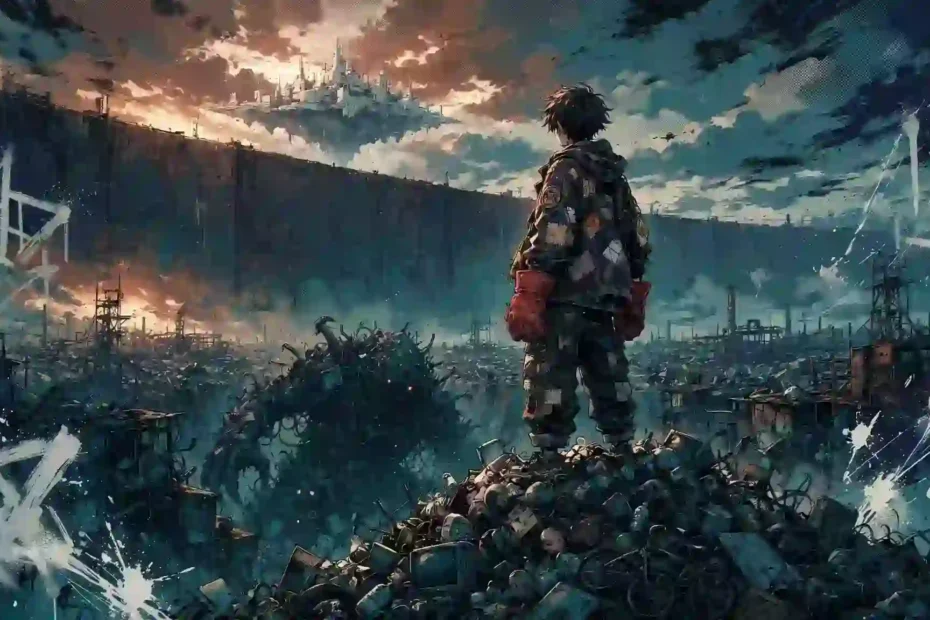
Trying to understand Gachiakuta from scattered summaries can leave the basics tangled: manga versus anime, the Sphere versus the Ground, and the difference between a Cleaner and a Giver. That matters because the series builds its action around the links between people, objects, and social status. This spoiler-light guide starts with the premise, then explains the world, cast, power system, themes, reading order, anime status, and the best way to begin.
What is Gachiakuta? A quick answer
Gachiakuta is a Japanese action manga by Kei Urana, with graffiti design by Hideyoshi Andou. It follows Rudo, a boy from a poor district who is falsely accused of a crime and thrown from the Sphere into the dangerous world below. There, he meets the Cleaners, learns about his unusual ability, and confronts a society that treats people and objects as disposable.
The anime adaptation is produced by bones film. Its first season aired across two consecutive cours beginning in July 2025, and the official anime site confirms that a second season is in production. The manga continues in Kodansha’s Weekly Shōnen Magazine, so new readers can choose the completed first anime season or start at the beginning of the source story.
Gachiakuta at a glance
| Detail | What to know |
|---|---|
| Format | Ongoing Japanese manga and a television anime adaptation |
| Manga creator | Kei Urana; graffiti design by Hideyoshi Andou |
| Publisher and magazine | Kodansha; Weekly Shōnen Magazine |
| Serialization began | February 2022 |
| Main character | Rudo, a young trash picker raised by Regto |
| Core setting | The Sphere above and the Ground below, with the Pit separating them |
| Main group | The Cleaners, who hunt dangerous trash beasts |
| Power terms | Givers and Vital Instruments |
| Anime studio | bones film |
| Season 1 | Aired in two consecutive cours beginning July 2025 |
| Season 2 | Confirmed; no premiere date appears in the official status material checked for this guide on 11 October 2026 |
| Recognition | The manga won the Shōnen category at the 50th Kodansha Manga Awards in 2026; the anime site lists three 2026 Crunchyroll Anime Awards wins |
Use this table as a quick reference, not as a substitute for the story. Names and roles become clearer as Rudo moves from the Sphere into the Ground and meets people who challenge his assumptions. Readers searching for manga details, anime updates, or terms such as Giver and Vital Instrument are looking at connected parts of Gachiakuta, not separate topics.
What is the story about?
Rudo grows up in a slum on the Sphere, where people labelled “tribesfolk” face discrimination from those with greater status. He survives by collecting discarded objects and lives with Regto, the man who raised him. After a crime he did not commit is pinned on him, Rudo is cast into the Pit, an act that cuts him off from the only home he knows.
The drop does not end his story. Rudo reaches the Ground, a harsh place shaped by the Sphere’s waste, and meets Enjin, a member of the Cleaners. The group hunts trash beasts, and Enjin recognizes that Rudo may be a Giver: someone able to draw power from an object. Rudo has to learn how this ability works while searching for the truth and deciding what justice means to him.
That setup gives the plot two engines. One is immediate survival: Rudo has to understand an unfamiliar place, build skill, and work with people he has only just met. The other is a larger question about power: who gets to decide that a person, a community, or an object has no value?
The story uses battles to move these questions forward rather than pausing the action for long lectures. A fight can show how a character thinks, what they protect, and what they believe an object is worth. For a new reader, that connection between action and meaning is one of the clearest ways into the series. At its core, Gachiakuta is a survival adventure shaped by the question of who gets to set the rules.
How does the world work? Sphere, Pit, and Ground explained
The Sphere is the elevated society where the story begins. It contains both wealth and poverty, but those groups do not enjoy the same safety or respect. The slum where Rudo lives sits on the wrong side of that divide, and its residents inherit a stigma attached to their background.
The Pit is the feared abyss into which Rudo is thrown. The Ground is the dangerous world beneath the Sphere, where cast-off waste and the people sent away from the city become part of the setting. In short, the Pit is the descent; the Ground is the place below.
| Term | Plain-language meaning | Why it matters |
|---|---|---|
| Sphere | The upper city and its divided society | It shows how status shapes who is protected and who is blamed |
| Tribesfolk | A label used for the slum population | The word signals prejudice built into the social order |
| Pit | The abyss Rudo is thrown into | It marks his forced separation from life in the Sphere |
| Ground | The dangerous world below | It is where Rudo must survive and where the Cleaners operate |
| Trash beasts | Monsters associated with discarded waste | They turn the society’s disposal problem into a physical threat |
| Cleaners | An organized group that hunts trash beasts | They give Rudo allies, training, and a new way to act |
| Raiders | A separate faction that comes into conflict with the Cleaners | Their presence adds political tension and questions about resistance |
Some summaries use “Pit” and “Ground” loosely. Keeping the difference in mind makes the opening easier to follow: Rudo is cast through the Pit and finds himself in the Ground, not simply transferred to another ordinary district. For anyone learning Gachiakuta’s setting, that distinction makes the early chapters easier to follow.
The setting also creates a strong visual contrast. The Sphere stands for a society that pushes unwanted things out of sight, while the Ground makes the consequences impossible to ignore. The story does not treat the lower world as an empty backdrop; its people, dangers, and tools shape every choice Rudo makes.
Who are the main characters?
The cast is larger than the first few people Rudo meets, but newcomers can follow the central relationships without memorizing every name. Each key character gives him a different kind of help or resistance: family, recruitment, training, teamwork, or conflict.
| Character | Role in the story | Beginner-friendly note |
|---|---|---|
| Rudo Surebrec | Protagonist and new Giver | He is resourceful, angry at injustice, and quick to notice the possible use in discarded things |
| Regto | The man who raised Rudo | The gloves he gives Rudo connect their relationship to the story’s object-based power system |
| Enjin | Cleaner and member of Team Akuta | He finds Rudo on the Ground, recognizes his potential, and brings him into the Cleaners |
| Zanka | Cleaner and Rudo’s trainer | Enjin appoints him to teach Rudo; his skill gives the newcomer a practical model to learn from |
| Riyo | Member of Team Akuta | Her presence helps make the team feel like a group with distinct styles, not a collection of copies |
| The Cleaners | Rudo’s organization and allies | They hunt trash beasts, but their work also brings him into contact with Ground communities |
| The Raiders | A competing faction | Their conflict with the Cleaners gives the story a political layer beyond monster fights |
To understand Gachiakuta’s cast, track the job each relationship does for Rudo rather than trying to remember every name at once. He is not written as a polished hero who understands the world from the start. He brings stubbornness, grief, and a habit of judging an object by what it can still do. Those traits help him act under pressure, but they can also make trust and cooperation difficult.
Enjin works as an entry point for both Rudo and the reader. He knows more about the Ground and the Cleaners, but he does not solve every problem for Rudo. Zanka adds the training side of the story, while Riyo and the wider team make clear that different people can approach the same danger in different ways.
Regto matters even when he is not present in a scene. His care for Rudo gives the boy a point of emotional connection before the plot throws him into the Ground. The gloves he gives Rudo also show how a personal object can carry meaning beyond its practical use.
What are Givers and Vital Instruments?
A Giver is a person who can bring out power through an object. The object becomes a Vital Instrument, often called a jinki in fan discussions. The manga introduces this idea through Rudo’s unusual ability and then expands it through other characters whose tools reflect their skills and relationships.
A Vital Instrument is not just a weapon with a special effect. Its shape, use, history, and connection to its owner help define how it works in a fight. An umbrella, a stick, gloves, or scissors can each produce a different style of action, so the system invites creative solutions instead of making every battle depend on the same kind of attack.
Rudo’s ability stands out because he can draw potential from objects that others have thrown away. That makes his power useful in a dangerous place, but it also supports the story’s central idea: an object’s price tag or current condition does not tell the whole story of what it can become. His best advantage is not simply force; it is noticing possibilities other people overlook.
For readers, three distinctions make the terminology easier. They separate the person, the object, and the job in the story:
- Giver: the person who can activate a special ability through an object.
- Vital Instrument: the object through which that ability takes form.
- Cleaner: a member of the organization that hunts trash beasts; many Cleaners fight, while others support the work in different ways.
The system has limits and personal rules, so it is better to learn each instrument as the manga introduces it than to assume every object works the same way. Later story details explain more, but the basic pattern is clear from the start: person, object, and purpose belong together. The Gachiakuta power system stays memorable because each ability grows out of an object with a particular use and personal connection.
What do the Cleaners and Raiders do?
An outfit called The Cleaners operates in the perilous world beneath the Sphere and hunts rubbish creatures. They are not all interchangeable fighters. Some members enter combat, while the broader organization includes people who train, organize, record, or support missions.
Rudo’s arrival gives the group a reason to teach a newcomer, but it also changes how he sees the Ground. The people there are not merely obstacles between him and revenge. Working with the Cleaners introduces him to communities, responsibilities, and forms of loyalty that complicate his original plan.
The Raiders provide a source of conflict with a different edge. Their clashes with the Cleaners create danger, but they also raise questions about who has the right to challenge an unfair system and what happens when anger becomes a strategy. In order to prevent future disclosures from being spoiled, this guide leaves their motivations vague.
The difference between a Cleaner and a Giver is simple: “Cleaner” describes a group or job, while “Giver” describes an ability. A person can be both, but the words do not mean the same thing. That distinction clears up many first-time questions about the series.
What themes make the story more than an action series?
The story’s strongest ideas grow directly from its setting. Social status is more than just a background detail, and trash is more than just scenery. Both influence how individuals are treated, the risks that characters encounter, and the survival strategies they employ.
Value and disposal
The Sphere throws objects away, then pushes people it considers unwanted toward the same edge. Rudo’s ability challenges that logic by revealing use and power where others see waste. The series asks readers to consider how often “worthless” means “not valued by the people in charge.”
Prejudice and inherited status
The label “tribesfolk” marks a group before individual actions can speak for them. Rudo’s life shows how stigma can limit a person’s choices long before a crime or mistake enters the picture. The Ground does not erase inequality, but it gives the story room to expose different kinds of power and exclusion.
Care and memory
A tool becomes important through more than its material. What a person has done with it, who gave it to them, and why they keep it can matter as much as its function. This gives the power system emotional weight by turning objects become little recordings of relationships.
Anger, justice, and responsibility
Although Rudo’s rage makes sense, the story does not address it as a comprehensive solution. Survival requires him to decide when to act alone, when to accept help, and whether revenge can repair anything. The action has a human cost because of their decisions.
Waste and environmental imagination
The story turns discarded material into a danger, a resource, and a symbol. It does not need to become a lecture about recycling to make the image work. A world built around what one group throws away naturally invites questions about who carries the consequences.
What makes the art and action distinctive?
The visual identity pairs urban grit with expressive, graffiti-inspired design. Hideyoshi Andou is credited with the graffiti design, while Kei Urana created the manga. Instead of creating a pristine dream backdrop, this mix gives the scene a distinct, lived-in sense. These decisions set Gachiakuta apart from more pristine, well-known fantasy city environments.
The action also gains variety from the Vital Instruments. A character’s tool influences distance, movement, defense, and timing, so a fight can feel different from one matchup to the next. Rudo’s habit of finding a use for an unlikely object makes improvisation part of his character, not just a trick for winning a scene.
The contrast between discarded materials and carefully drawn character details reinforces the central theme. Even if the world is hazardous and filthy, the art does not view its inhabitants as disposable. Their clothes, equipment, and body language help show what they value and how they adapt.
Viewers who prefer fast, highly colored action may enjoy the anime’s movement and sound design, while manga readers can take more time with the page composition and visual lettering. The setting’s harshness is not eliminated by any format. The tone stays intense, with bursts of humor and team chemistry breaking up the bleakest stretches.
Is the manga different from the anime?
The manga is the original version of the story, and the anime brings it to the screen with motion, voices, music, and color. The official anime site credits bones film as the animation studio and describes the first season as two consecutive cours beginning in July 2025. Both formats follow the same core premise, but they deliver it differently. One useful way to compare the Gachiakuta manga and anime is to notice what sound and motion add to the same encounter.
| Format | Best for | What to expect |
|---|---|---|
| Manga | Readers who want the original page-by-page presentation | Panel composition, printed or digital reading, and direct access to the ongoing source story |
| Anime | Viewers who enjoy voice performance, music, color, and movement | A screen adaptation with timed scenes and animated action |
| Both | Fans who want to compare storytelling choices | A chance to notice how pacing, sound, and visual detail shift between formats |
If you like studying an artist’s page design, begin with the manga. If you want an easy first taste of the premise and characters, start with episode one. If you enjoy the world, trying the other format afterwards can reveal details you may have moved past the first time.
The manga remains the safest choice for someone who wants to follow the story beyond the first season. A screen adaptation can compress or rearrange material, so there is no need to guess a chapter number from a finale. Starting the manga at volume one avoids missing early details and lets you experience the original pacing.
What order should a new reader or viewer follow?
There is no complex franchise timeline to memorize before starting. The release order makes the plot easier to follow. with the manga beginning at its first chapter and the anime beginning at its first episode.
- For manga readers: Start at volume one, chapter one. Continue in the published chapter and volume order because the setting and power rules build on earlier scenes.
- For anime viewers: Watch season one from episode one through its finale. The first season aired as two consecutive cours and reached episode 24 in December 2025, according to the official anime news page.
- For people switching formats: If you finish the anime and want more, consider reading from volume one rather than jumping to a guessed chapter. This gives you the cleanest understanding of character introductions and world details.
- For people waiting for the next season: The manga is the direct route to continue exploring the story. Check current official announcements for adaptation news before relying on a release date posted elsewhere.
When reading online or buying volumes, use authorized editions available in your country. The official English-language manga page is hosted by Kodansha’s K MANGA service, while print and digital availability can vary by region and retailer. This guide does not include external links, so search for the publisher or service by name.
Is Gachiakuta season 2 confirmed?
Yes. The official anime website confirms that season two is in production, following the first season’s 24th episode in December 2025. As of 11 October 2026, the official status material used for this guide does not list a premiere date, so treat a specific date or release window as unconfirmed unless the production team announces it.
The same official site describes the first season as a two-cour broadcast that began in July 2025. It also lists recognition for the anime at the 2026 Crunchyroll Anime Awards, including Best New Series, Best Character Design, and Best Background Art. These details give new viewers useful context, but the story itself is the best reason to decide whether to watch.
Because anime schedules can change, check official announcements shortly before planning a watch party or subscription. Streaming catalogues also depend on location, licensing, language, and date. Use a licensed service in your region rather than assuming a platform carries every season everywhere.
Who will enjoy this series?
This story may fit you if you enjoy action with a strong setting, unusual powers, and characters who have to grow through mistakes. It may also appeal if you like urban fantasy, dystopian societies, found-family dynamics, and visual design that borrows from street art.
It may be a poor fit if you want a gentle, low-conflict story. The series includes violence, dangerous creatures, prejudice, grief, and a harsh survival environment. Its jokes and team banter add relief, but they do not turn the central conflict into a light comedy.
A useful way to decide is to try the official opening chapter or the first anime episode before committing to a long read or watch. Pay attention to whether the mix of rough setting, expressive art, and object-based powers holds your interest. If it does, the wider cast and themes have plenty of room to develop.
How the topic connects: a simple entity map
A clear topic map helps new fans connect the names they encounter in search results, episode discussions, and manga listings. The central entity is the series itself, but several related subjects explain its world and creative team.
| Core topic | Related entities | How they connect |
|---|---|---|
| Original manga | Kei Urana, Hideyoshi Andou, Kodansha, Weekly Shōnen Magazine | Creator, graffiti design, publisher, and serialization home |
| Anime adaptation | bones film, season one, confirmed season two | Screen version and current production status |
| Main character | Rudo, Regto, Enjin, Zanka, Riyo | Family, recruitment, training, and team relationships |
| Setting | Sphere, slums, tribesfolk, Pit, Ground | The social and physical divide that drives the plot |
| Power system | Givers, Vital Instruments, objects | The link between character, tool, and ability |
| Conflict | Cleaners, trash beasts, Raiders | The organization and threats that shape action and politics |
Because Gachiakuta spans a manga, anime, factions, a setting, and a distinct power system, fans often search for several connected answers. For a deeper topical cluster, the most useful follow-up subjects are a spoiler-safe character guide, a plain-language Vital Instrument explainer, a glossary of Sphere and Ground terms, a manga reading guide, and an anime status update. Each page should answer a different fan question instead of repeating this overview with a new headline.
A strong reference page also needs maintenance. Recheck serialization, adaptation, awards, and streaming facts when official news changes; mark the date of that update. Google’s Search Central guidance favors helpful, reliable pages made for people, so clear sourcing and a real author’s contribution matter more than repeating a target phrase.
Frequently asked questions
What is Gachiakuta about?
It follows Rudo, a boy from a stigmatized slum who is falsely accused and thrown from the Sphere into the Ground. He joins the Cleaners, learns about Givers and Vital Instruments, and searches for answers in a society built around disposal and exclusion.
Is the Gachiakuta manga finished?
No. Kodansha’s official digital listing and the anime site describe an ongoing manga, so it has not reached a published ending as of this guide’s review date. Chapter and volume counts change; check the publisher’s current catalogue for the latest release information.
What is a Giver in Gachiakuta?
A Giver is a person who can draw supernatural power through an object, which becomes a Vital Instrument. The person and the instrument are connected, but the terms name different things.
Is season two confirmed, and when will it come out?
Season two is confirmed and in production, according to the official anime site. The official status material checked on 11 October 2026 does not provide a premiere date, so no exact date should be presented as confirmed.
Should I read the manga before watching the anime?
No. The anime provides a complete starting point, and the manga begins at volume one for readers who prefer the source format. If you move from the anime to the manga, starting at volume one is the safest option for catching details and differences in pacing.
Where can I read or watch it legally?
Use Kodansha’s authorized manga editions and licensed anime services available in your country. Rights and catalogues differ by region, so check the publisher and local streaming listings rather than relying on an old platform list.
Your next step as a new fan
Start with chapter one or episode one, then choose one thread to follow: how people decide what has value, who controls the Sphere and the Ground, or how an object can carry a relationship. If you already read or watch the series, share which character or Vital Instrument first caught your attention. The story’s most lasting question is simple: what deserves to be thrown away, and who gets to decide?